

This page will not fit into a tiny viewport. Please choose a full-size monitor with a full-width window or select the abridged New Wave pages.


Petzl Neox Prototype
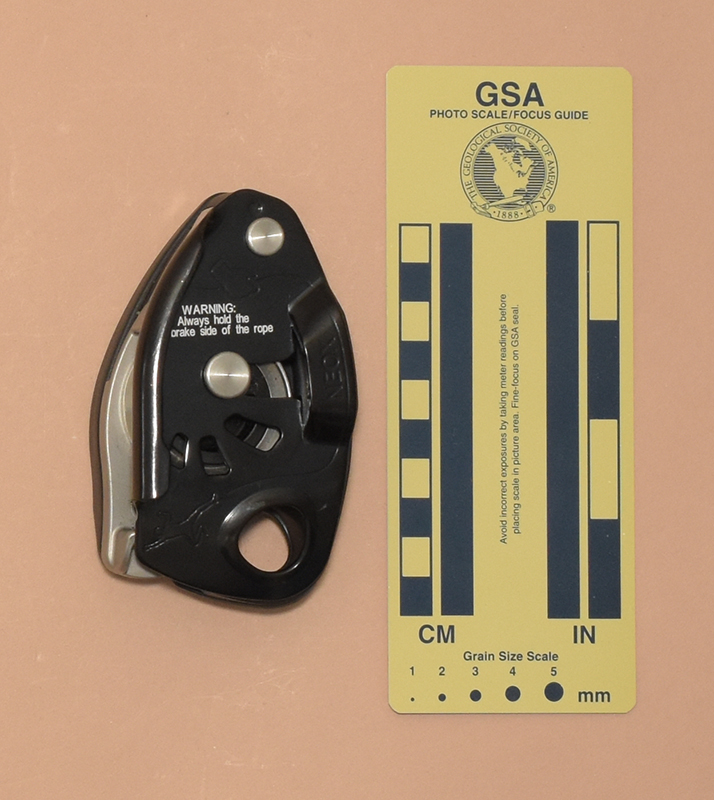
Petzl Neox
|
|
|
| Prototype | Production |
In 1930, Fernand Petzl discovered caving at the age of 17. Back at his workshop after each excursion to the depths, Fernand imagined new tools for exploring darkness and heights. With his inventions taking up more and more space, he decided to create his own workshop, sparking the growth of his small business. Working together brought Fernand closer to his son, Paul, who was determined to grow the business. From the beginning, Paul's wife Catherine took care of the accounting.
Paul Petzl, a mechanical engineering student, had already been thinking about creating a real company and began to plan out his first investments. In 1970, the Petzl brand was created. Five years later, the first company headquarters was established at the foot of the Dent de Crolles. In the years that followed, the number of employees increased as the company experienced local and international growth.
Petzl is a family business that, over the years, has become the largest European manufacturer of personal protective equipment for those who work and play in darkness or at height. All Petzl products are invented and developed at their headquarters in the heart of the French Alps.
The Petzl brand is present in over 55 countries with 85% of their sales made internationally. More than 9 million products are sold every year, and 10 million people use Petzl personal protective equipment every day.
[ Top | Production | Return to Lever Box Belay ]
|
|
 |
| Front | Rear |
 |
 |
| Left | Right |
 |
 |
| Front: Open for Rigging | Rear: Handle Partially Extended |
Petzl sent me this prototype to test in 2024. Thank you Sébastien Petzl for arranging this opportunity for me.
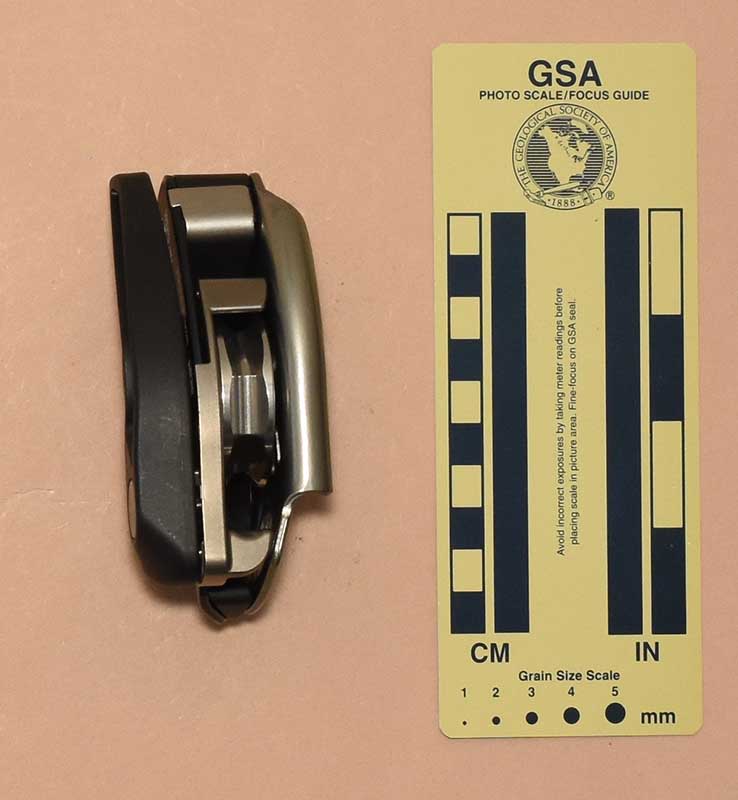
My Neox prototype is 106 mm. tall, 62 mm. wide, 43 mm. high, and weighs 234 g.
My Neox prototype strongly resembles the later Grigri, also known by the more sensible name Grigri 3. I will background the Grigri 3 description in gray and indicate the changes in black:
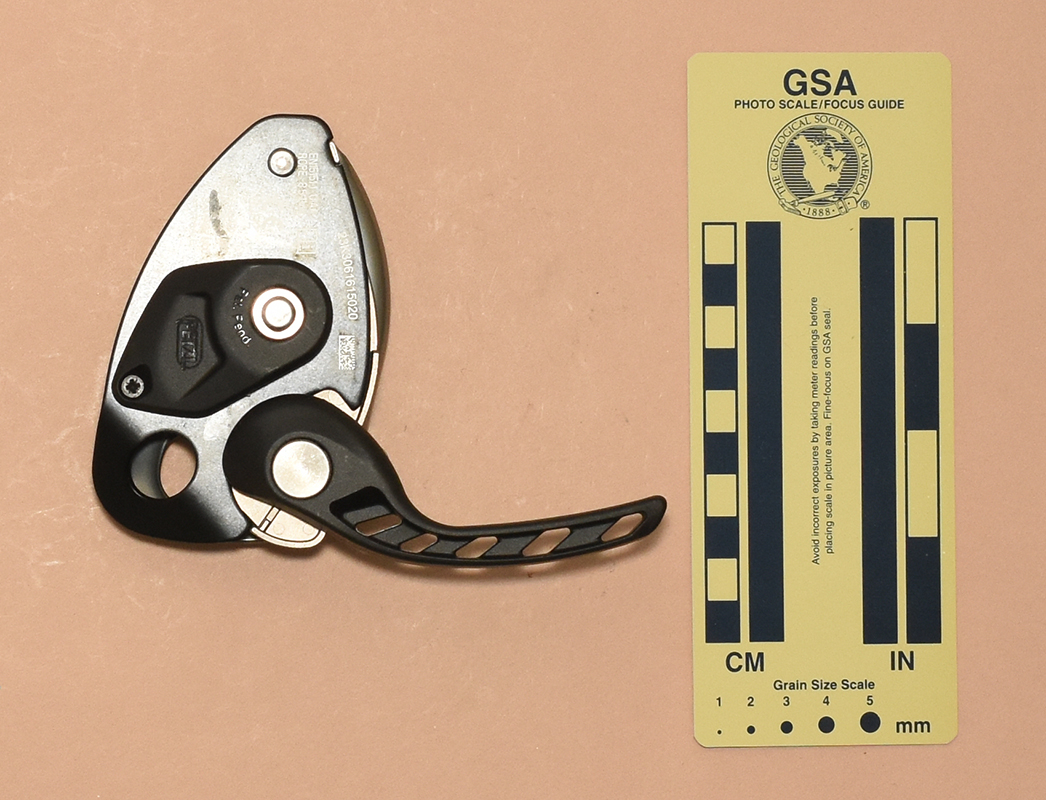
My Neox prototype consists of a spring-loaded cam assembly mounted between a back plate and a swinging front plate. The two plates are stamped from 2.5 mm. aluminum alloy and then anodized. The plates are shaped roughly like a avocado. The two plates are loosely riveted together near the top, with a 14.5 mm. stamped stainless steel anvil that serves as spacer between the two. The front plate can rotate about 135° clockwise with respect to the rear plate and spacer, allowing one to open the Grigri for rigging. The two plates have inward bends near the bottom, where 17.7 × 15.3 sub-triangular attachment holes are punched through the sloping portion of the plates. The hole on the front plate is surrounded by a border that is stamped outward. The front plate has a slot for capturing the head of the cam axle, and an arch to the right of the slot to provide support. The upper left half of the front plate is bent forward to provide a 10.8 mm. diameter curved surface for the rope to run over. A plastic spine fills the right side of the device between the plates. A beveled plastic fairing is screwed to the back plate.
The cam is cast from stainless steel. The cam can rotate about 45° clockwise with respect to the rear plate, but a strong spring opposes this rotation. If the belayed climber falls, the cam rotates clockwise, and the top surface of the cam squeezes the rope against the anvil. A spring-loaded plastic handle on the rear of cam gives the belayer more leverage to release the cam.
Unlike the Grigri 3, the rope does not run directly over the Neox' cam. The Neox Cam has an eccentric roller attached to its inside surface. The roller has eight grooves on its periphery, increasing rope friction. The roller turns with some resistance.
The front plate is stamped with "NEOX" and rigging illustrations. The spine is printed with the Petzl logo. The cam assembly has the a rigging illustration consisting of a roped climber inside an arrow cast into it. The rear plate is printed with "23K3061615020,", an iQR code, "EN15151-1," "UIAA," "ROPE 9.5-11mm," a book-with-an-"i" icon, "Petzl," "F-38920," "Crolles Cidex 105A;" and "SAMPLE NOT FOR SALE." The fairing has the Petzl logo and "Patented" molded into it. The bottom of the cam was hand-lettered with "NR 30."
The devices in the Grigri series are popular belay devices. The Neox modifies the latest Grigri (i.e., the Grigri 3) by introducing the eccentric roller. This allows the rope to run more smoothly than it does on the Grigri 3 where the rope slides over the cam. The smoother operation of the Neox makes belaying sport climbers easier since one can quickly feed or take in rope with less chance of the cam locking. It also facilitates releasing a locked cam. The down side is that the Neox is less tolerant of poor belaying technique.
 |
Warning: Grigri users who have developed bad habits should unlearn these before using the Neox. |
|
In June 2023, Sébastien Petzl offered to arrange for me to test the forthcoming Petzl Neox, with the natural conditions that I couldn't show the product or post anything before the product launch. I enthusiastically agreed, and after completing the necessary paperwork, I received my Neox Prototype in January 2024. After its release in June 2024, I contacted Petzl and confirmed that I was released from the pre-release confidentiality conditions.
[ Top | Prototype | Return to Lever Box Belay ]
|
|
 |
| Front | Rear |
 |
 |
| Left | Right |
 |
 |
| Front: Open for Rigging | Rear: Handle Extended |
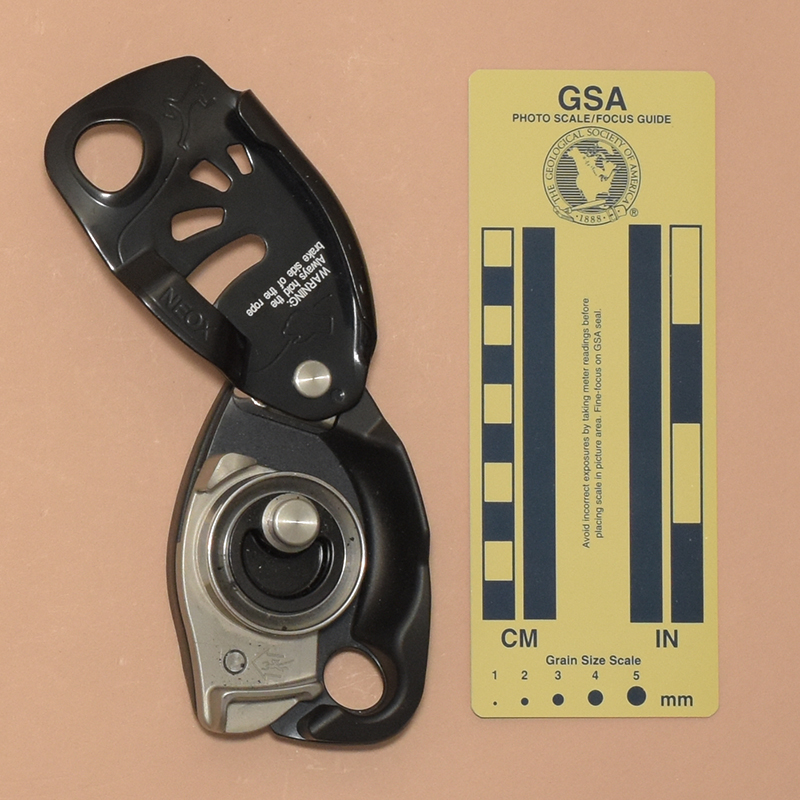
I acquired two Petzl Neox belay devices in like-new condition on eBay from Stone Park Pawn Shop in 2024.
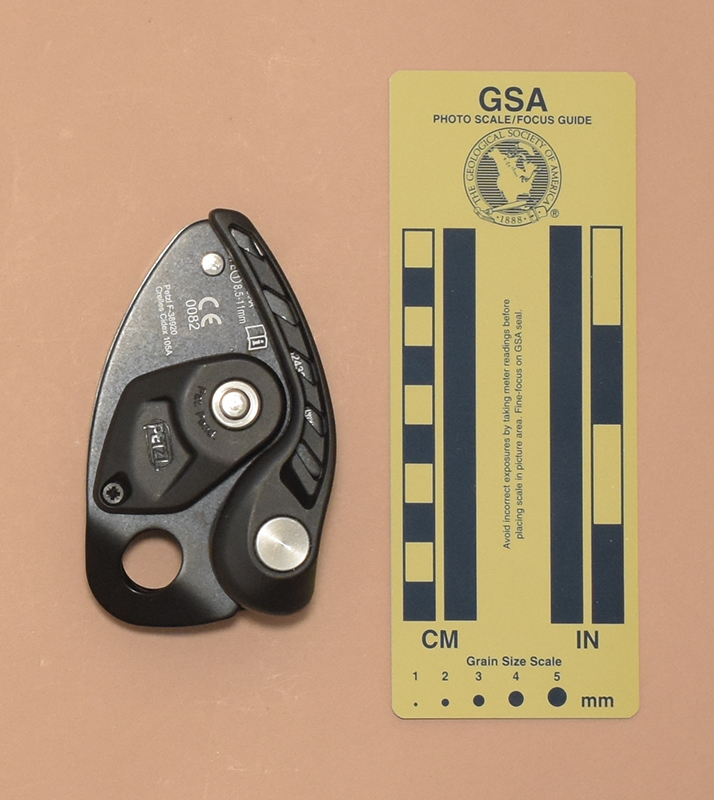
Each Neox is 106 mm. tall, 62 mm. wide, 43 mm. high, and weighs 236 g.
Each Neox is essentially identical to my prototype, but the markings differ.
The front plate is stamped with "NEOX" and rigging illustrations, and printed with "WARNING: Always hold the brake side of the rope." The spine is printed with the Petzl logo. It has a confusing sticker that shows a rigged Neox, a skull-and-crossbones inside a red triangle, and a red hand. The cam assembly has the a rigging illustration consisting of a roped climber inside an arrow cast into it. The rear plate is printed with "24G0582432939" on one (…977 on the other), an iQR code, "EN15151-1," "UIAA," "FOR ROPE 8.5-11mm," a book-with-an-"i" icon, "CE0082," "Petzl," "F-38920," and "Crolles Cidex 105A." The fairing has the Petzl logo and "Patented" molded into it.
The devices in the Grigri series are popular belay devices. The Neox modifies the latest Grigri (i.e., the Grigri 3) by introducing the eccentric roller. This allows the rope to run more smoothly than it does on the Grigri 3 where the rope slides over the cam. The smoother operation of the Neox makes belaying sport climbers easier since one can quickly feed or take in rope with less chance of the cam locking. It also facilitates releasing a locked cam. The down side is that the Neox is less tolerant of poor belaying technique.
The sticker on the spine is confusing and potentially dangerous if misinterpreted. It is intended to mean "never let go" but to me it says "Don't burn your hand by braking." That is NOT what it means. The Neox will not hold a fall if the belayer does not brake properly.
The Production model has a labeled 8.5 mm. minimum rope diameter compared to 9.5 mm. for the Prototype. This is not a design change, it merely reflects a conservative rating given prior to CE testing.
|
Warning: Grigri users who have developed bad habits should unlearn these before using the Neox. |
|
[ Top | Prototype | Production ]