

This page will not fit into a tiny viewport. Please choose a full-size monitor with a full-width window or select the abridged New Wave pages.


Lifeguard

Safeguard
|
|
|
| Lifeguard | Safeguard |
Born in South Korea, Young Chu began climbing in the 1970s. Gear was scarce, so using his mother’s sewing machine, Young began crafting his own gear. His homemade equipment caught the eyes of his friends, and before long, Young was outfitting his circle of climbing friends.
In 1987, Young launched Nelson Sports, Inc., designing shoes for mountain sports. He became the head designer for Five Ten. In 2002, Young founded Mad Rock, driven by a singular goal: to create affordable, high-performance climbing shoes. Since then, Mad Rock has added hardware and accessory lines to their offerings, but shoes remain their main focus.
[ Top | Safeguard | Return to Lever Box Belay Devices ]
|
|
 |
| Front | Rear |
 |
 |
| Front: Open for Rigging | Top |
 |
 |
| Rear: Open for Rigging | Bottom |
I acquired my Mad Rock Lifeguard from Camp Four in 2016.
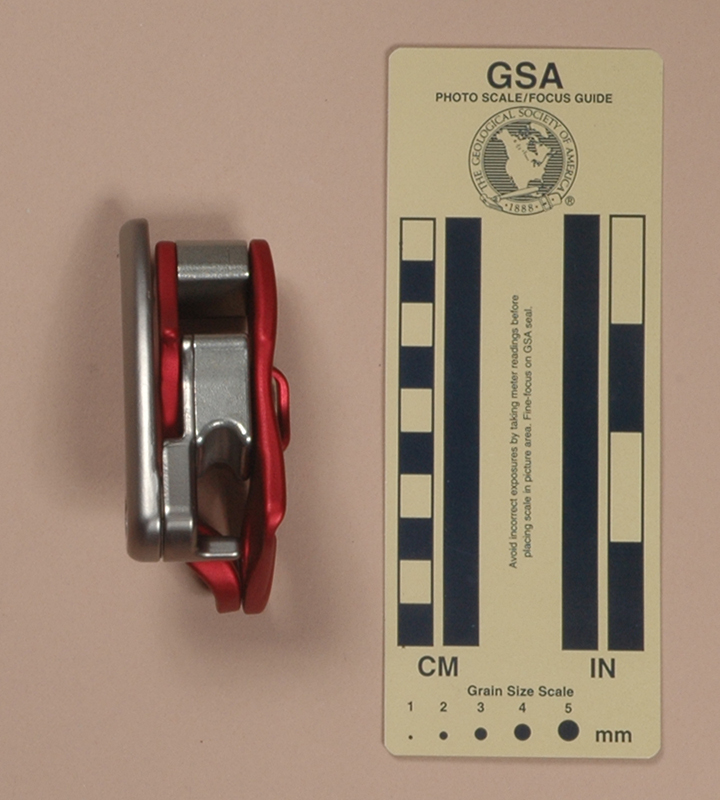
The Mad Rock Lifeguard is 47 mm. long, 94 mm. wide, 39 mm. high, and weighs 155 g.
The Lifeguard consists of a forged aluminum back, forged aluminum cover, cast stainless steel cam, stainless steel anvil, forged aluminum cam arm, aluminum handle, and miscellaneous parts. The back and cover are irregular in shape. The cam rotates on a pin riveted to the center of the back plate, with a strong spring holding the cam in the open direction. The lever rotates on a pin in the end of the cam lever, and a spring holds the lever in the closed position. The anvil is a block pinned to the right end of the back plate. The cam and anvil provide a rope channel. The front cover pivots on the anvil rivet.
The front of my Lifeguard has a climber icon, a hand-holding-a-rope icon, and the Mar Rock logo forged in raised relief. The inside of the back piece has a hand-holding-a-rope icon forged into it. The cam has a different Mad Rock logo forged into it, and the cam arm has a climber icon forged into it. The back of the device has "LIFEGUARD," "WARNING: READ BEFORE USE," a book-with-an-"i" icon, "8.9-11 mm," "CE 2008," and "PF1" printed on it, and "MAD ROCK" forged in raised letters.
The Lifeguard is well made. It is a complex device that requires more training and familiarization than most devices, much like the Petzl Grigri. Like the Grigri and some others, the Lifeguard provides an autolocking feature that may be useful on big walls where the belayer is snoozing, but I’d rather have my second awake. Of the bunch, the Lifeguard is one of the most compact - a nice feature for those who don't want to haul excess baggage.
Although the details are different, the Beal Birdie has many similarities to the Mad Rock Lifeguard. Of the two, the Lifeguard is much lighter.
[ Top | Lifeguard | Return to Lever Box Belay Devices ]
|
|
 |
 |
| Front View | Rear View | Side View |
 |
 |
| Front View: Open for Rigging | Rear View: Open for Rigging |
I acquired my Mad Rock Safeguard from Mad Rock Climbing in 2019.
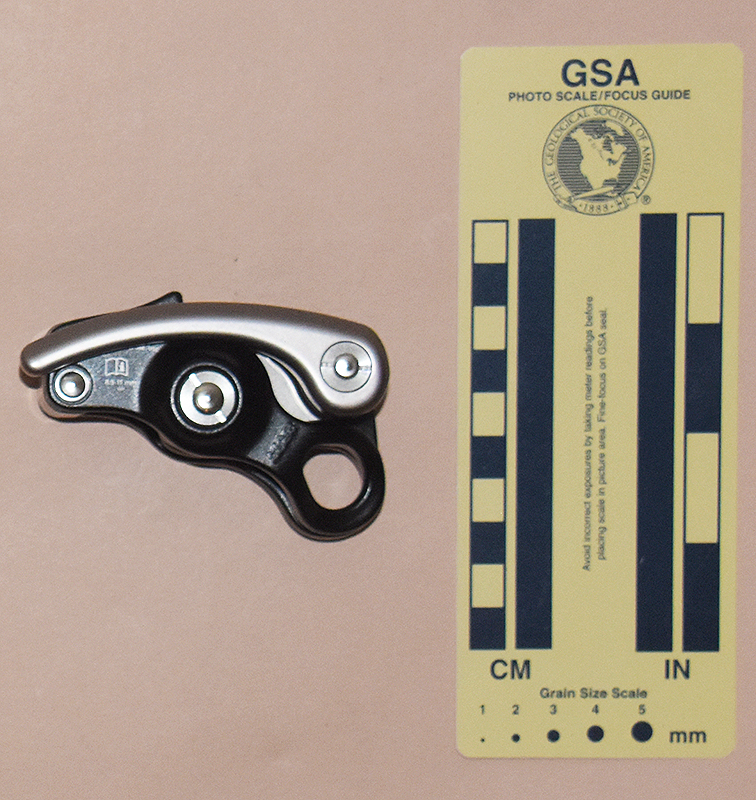
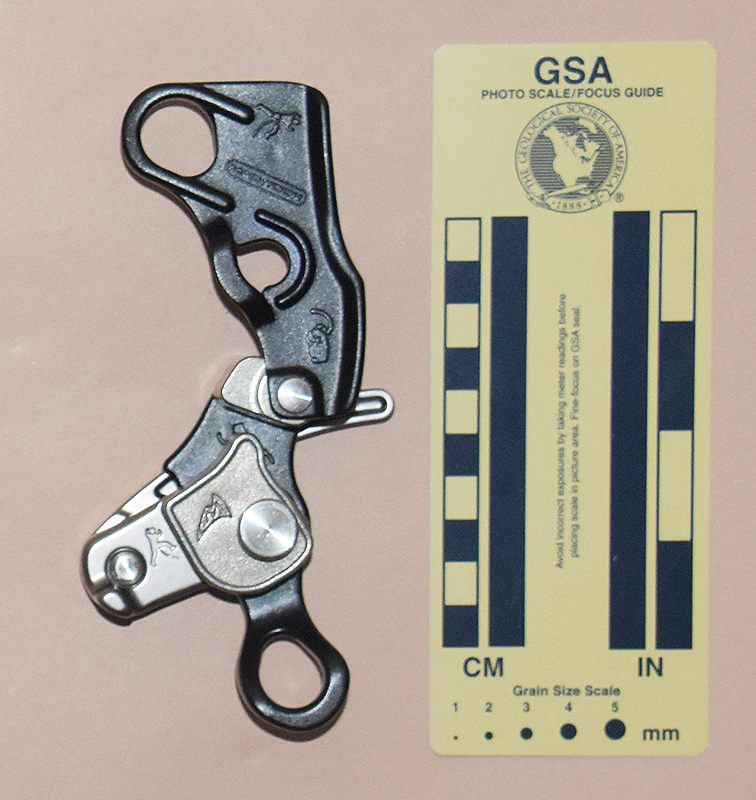
The Mad Rock Safeguard is 47 mm. long, 83 mm. wide, 36 mm. high, and weighs 153 g.
the Safeguard is identical to the Lifeguard except tit omits the internal spring.
The front of my Lifeguard has a climber icon, a hand-holding-a-rope icon, and the Mar Rock logo forged in raised relief. The inside of the back piece has a hand-holding-a-rope icon forged into it. The cam has a different Mad Rock logo forged into it, and the cam arm has a climber icon forged into it. The back of the device has "SAFEGUARD," "WARNING: READ BEFORE USE," a book-with-an-"i" icon, "8.9-11 mm," "CE 2008," and "SH1" printed on it, and "MAD ROCK" forged in raised letters.
Richard Delany asked Mad Rock to supply a version of their Lifeguard without the return spring in the cam. His idea was that when used as a positioning or descent device, the rope will not slide through if the device is unweighted or used in non-vertical environments.
Although the difference between the Safeguard and Lifeguard seems minor,the two perform very differently. The Safeguard is the preferred device for users who need to lock the device in position (not that I trust this without backup). The Safeguard does not perform well for belaying lead climbers since it tends to lock each time the climber tries to advance. The spring in the Lifeguard prevents this.
[ Top | Lifeguard | Safeguard ]