

This page will not fit into a tiny viewport. Please choose a full-size monitor with a full-width window or select the abridged New Wave pages.

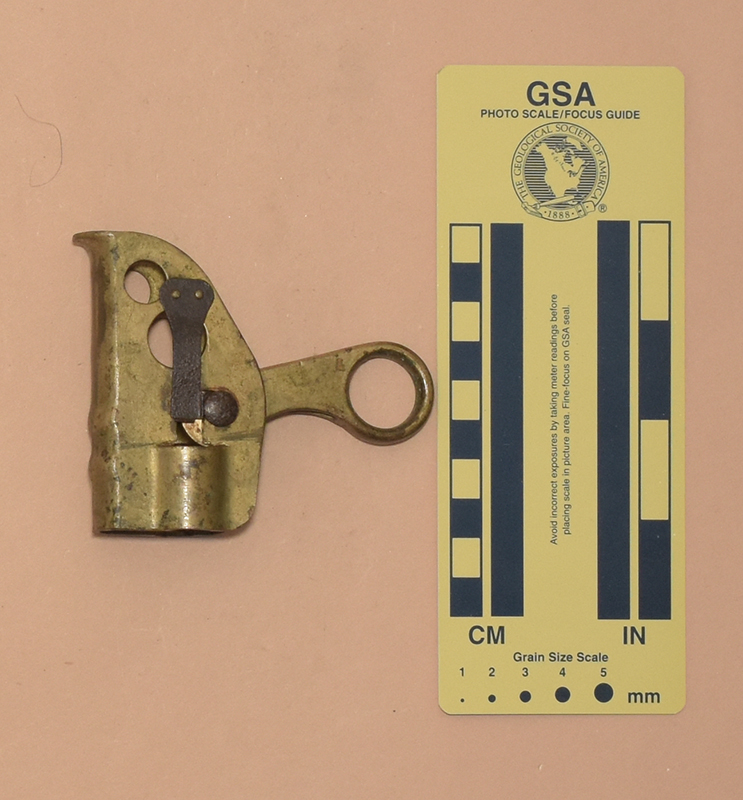
|
|
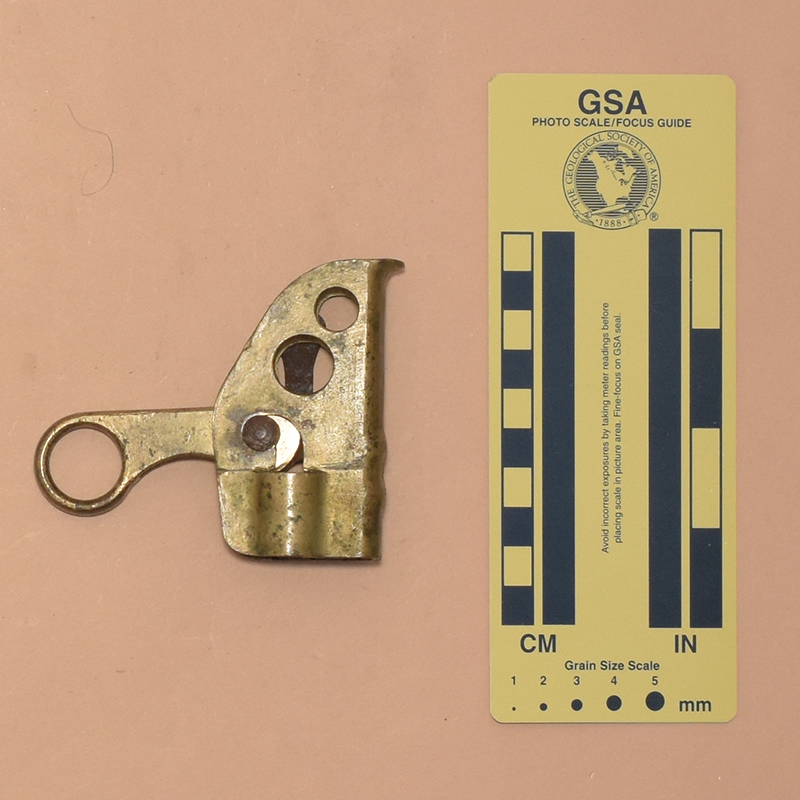 |
| Front | Rear |
 |
 |
 |
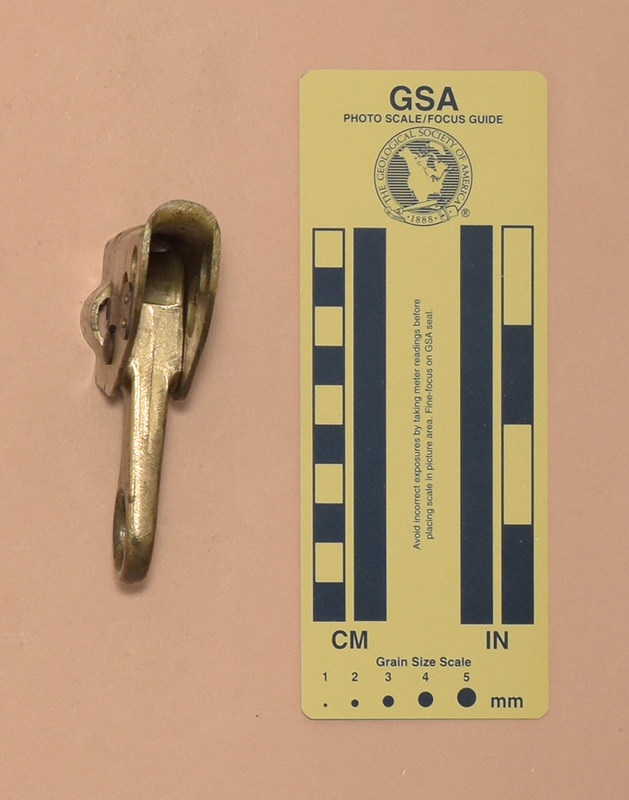
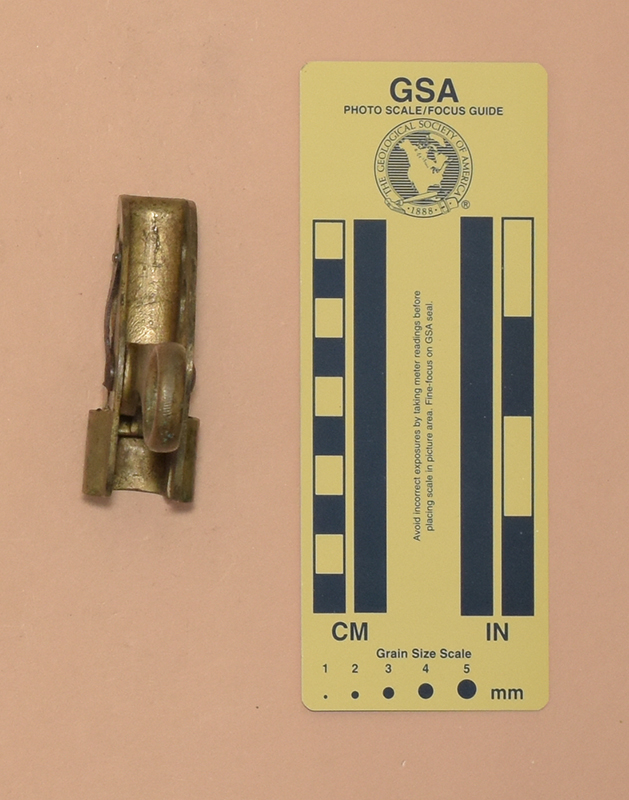
| Top | Side | Open for Rigging |
 Stéphane Pennequin sent me a pair of these ascenders in 2024.
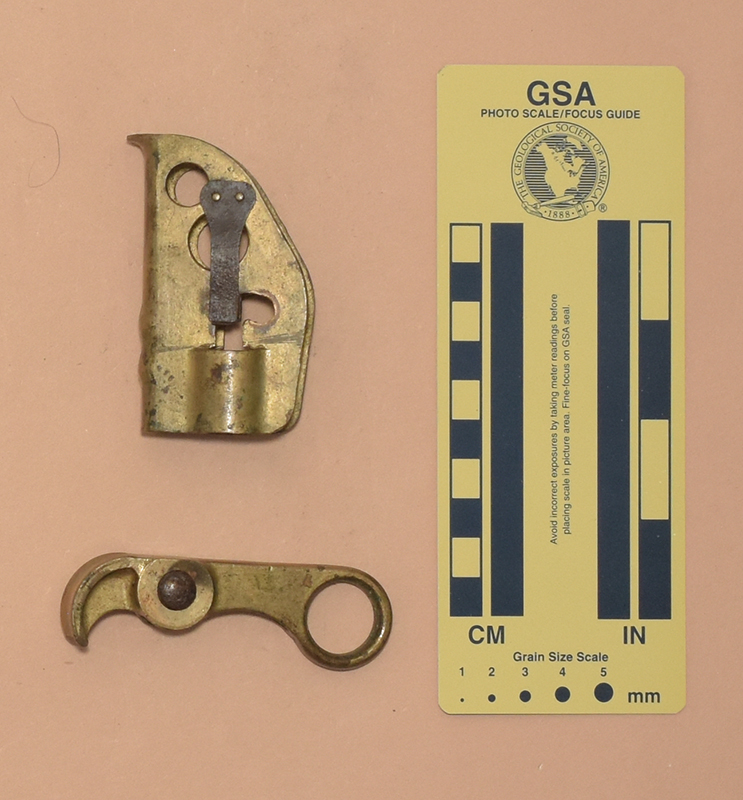
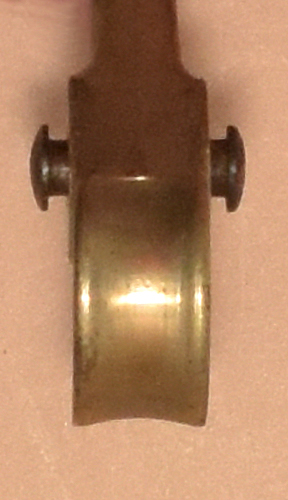
This ascender is 75 mm. tall, 88 mm. wide, 28 mm. thick, and weighs 154 g. The shell is 1.8 mm. stamped steel shaped to form a 15.2 mm. U-shaped channel. Г–shaped slots on each side accept the cam axle, and a spring steel clip riveted to the front of the shell holds the axle in place.
The cam appears to be forged. The cam face is smooth with no teeth.
There are no markings on this ascender.
These are small ascenders that open and close easily, making rigging fast and simple. A disadvantage of the design is that they disassemble into two pieces, doubling th opportunity to drop a key component.
The smooth cam face requires a long arm on the eye side of the cam to provide enough leverage to hold. As a result, the body of the ascender turns almost 90° when loaded, resulting in considerable lost motion and inefficiency.
I do not know what steel alloys are used for the shell. They are not stainless, but they are barely magnetic.
Stéphane showed this ascender in The Nuts Museum and captioned it with
“Singe” “Monkey” (France), 1949! The early days of using the "cam" on a caver's tool.
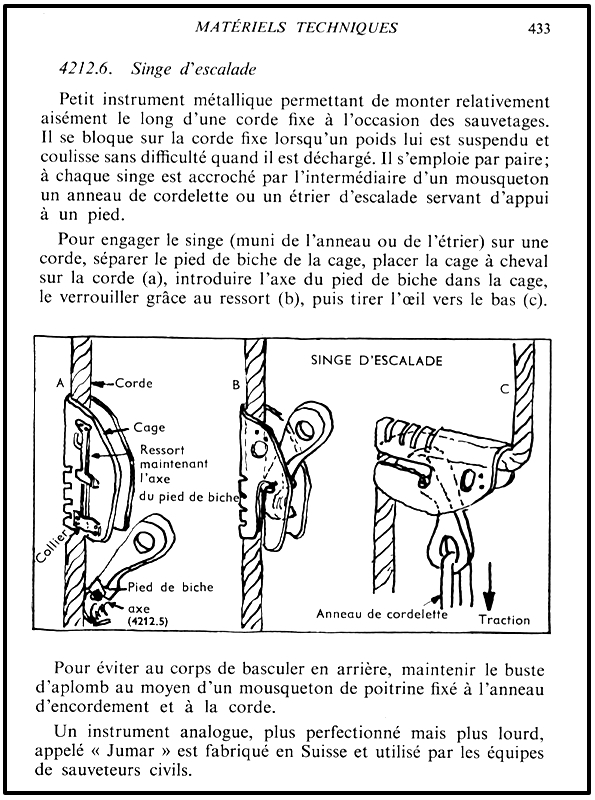
His illustration shows a page from a 1949 Military Manual that a common friend scanned for him.
Jean-Luc Lamouroux provided this additional information:
1949 seems a little early. I would say 1970s or 1980s. You can find it a few times on the Le Bon Coin private sales site. The author must be confused with Henri Brenot's monkey from the 1940s.
This ascender does not match the drawings of Henri Brenot's monkey from the 1940s as shown in Guerin's book (H. P. Guerin, 1944. "Spéléologie, Manuel technique." Edition J. Susse, 1st edition, 1944).
This ascender closely matches the drawings in the 1949 French military manual for mountain troops[1] and a simillar drawing in the 1966 edition[2]. The match is not exact, but it is enough to conclude that they are the same device (but possibly different versions).
 |
 |