

This page will not fit into a tiny viewport. Please choose a full-size monitor with a full-width window or select the abridged New Wave pages.

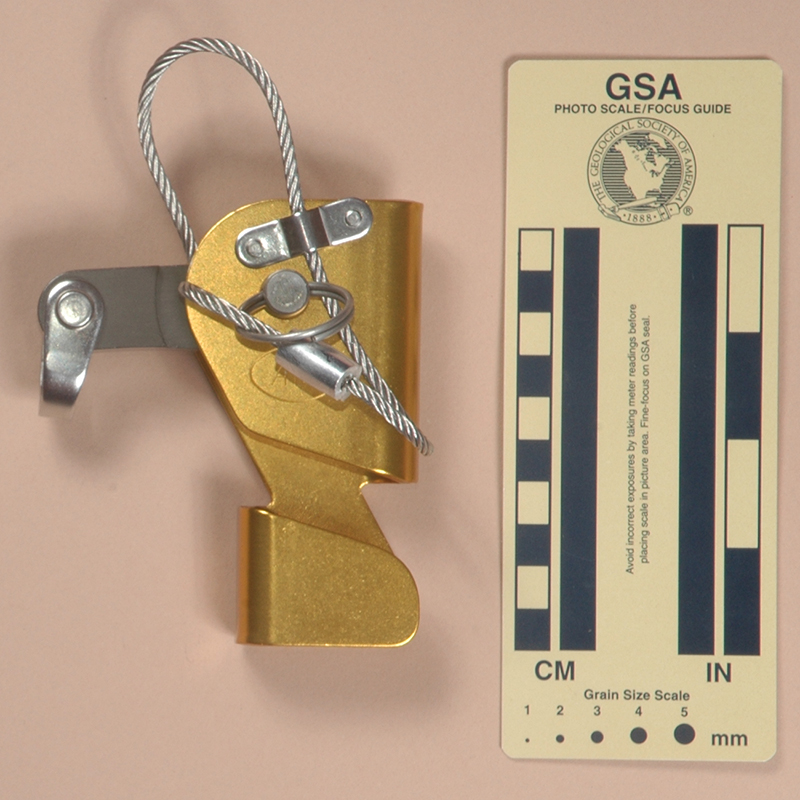
Version A
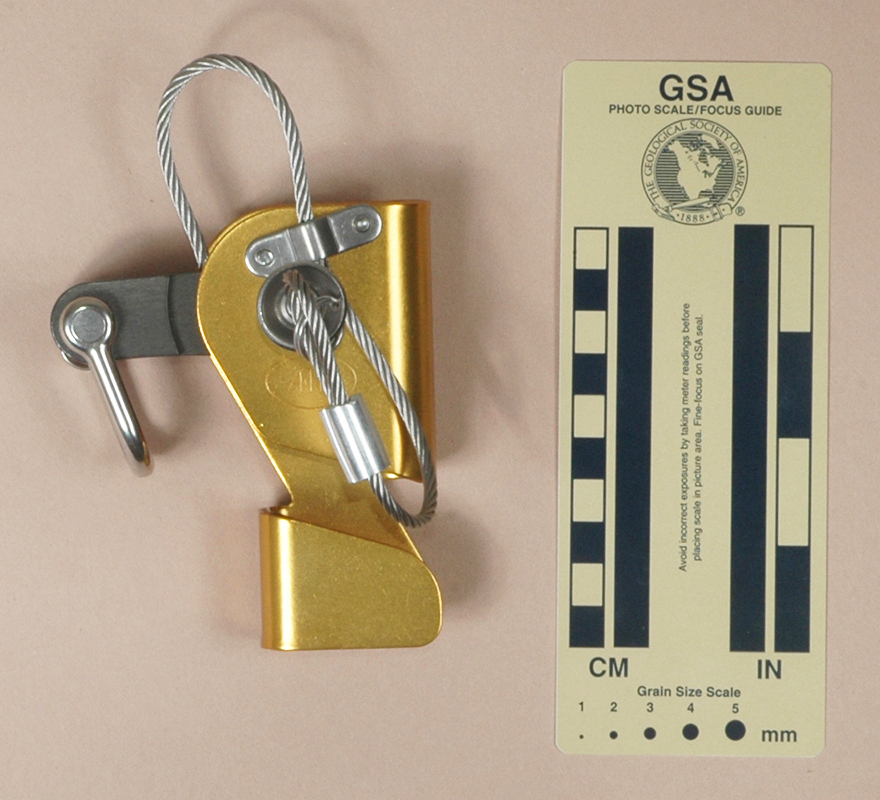
Version B
|
|
|
| Version A | Version B |
Etienne Giroire founded ATN in 1985 to supply sailing equipment and sailboat gear. They developed the ATN ascender was designed as part of a system (basically a two-leg Texas) to get to the masthead safely.. CIM made the ascenders for ATN.
CMI has been making products for climbers, mountaineers, arborists, ropes course professionals, and fire service and industrial safety experts since 1964.
Minnesota native Gregg Blomberg moved to Denver, Colorado to attend a two-year college to study gunsmithing. He caught the climbing bug and decided to use his knowledge about metalworking to manufacture pitons. Up to that time, a few climber/blacksmiths in America were forging and selling “hard metal” reusable pitons from alloy steels. Gregg thought he could improve on the design of the piton and began manufacturing out of a garage in Denver in 1963. Gregg then designed and manufactured the first American-made piton hammers. He founded Colorado Mountain Industries (CMI) in 1964. After selling about 450 piton hammers, Gregg realized the market in the US was saturated, so he licensed a West German company, Salewa, to manufacture his designs in Europe. In 1966, Gregg decided to sell CMI to Redfield Gunsight Company, also in Denver.[1]
In 1972, CMI was still a division of the Redfield Gunsight Company and was managed by Don Burris. In 1971, he left Redfield to start his own company, Burris Optics, so it was decided to arrange for the sale of the CMI division. Bev Feldstein, an ambitious outdoor enthusiast and owner of The Speleo Alpine Shop in Cincinnati, became excited about acquiring CMI and moving it to Ohio. By early 1973, Bev had formed a corporation of five people: herself, daughter Linda, Joe Day, Todd Tomlinson, and Ethan Becker. Ethan had the financial resources and became the owner. By the summer of 1973 CMI had moved to the eastern Cincinnati suburb of Fairfax. Ken Macke joined the team as a designer and production manager.[1]
In 1975, CMI also began to produce some private label climbing gear for other suppliers. They were approached by Ron Kirk to manufacture a set of five wedge-shaped chocks, like the “Gendarme Nuts.” The relationship between CMI and Ron quickly grew. By 1976, CMI was losing money at a steady pace, and Ethan’s accountant convinced him to scale back operations and to find a buyer for CMI. [1] Ron Kirk purchased CMI in 1978 and moved the company to Franklin West Virginia. It remains there, family owned and operated under Ron Kirk's leadership.
[ Top | Version B | Return to L.C. Ascenders ]
|
|
 |
| Front | Rear |
 |
| Open for Rigging |
This one has a longer story than most: In 2015, I acquired six ascender bodies from Joseph M. Zambelli. He then offered me three more, along with seven cams, and some other parts for other ascenders, so I acquired these as well. In 2016, I acquired a complete ascender from ATN Inc.
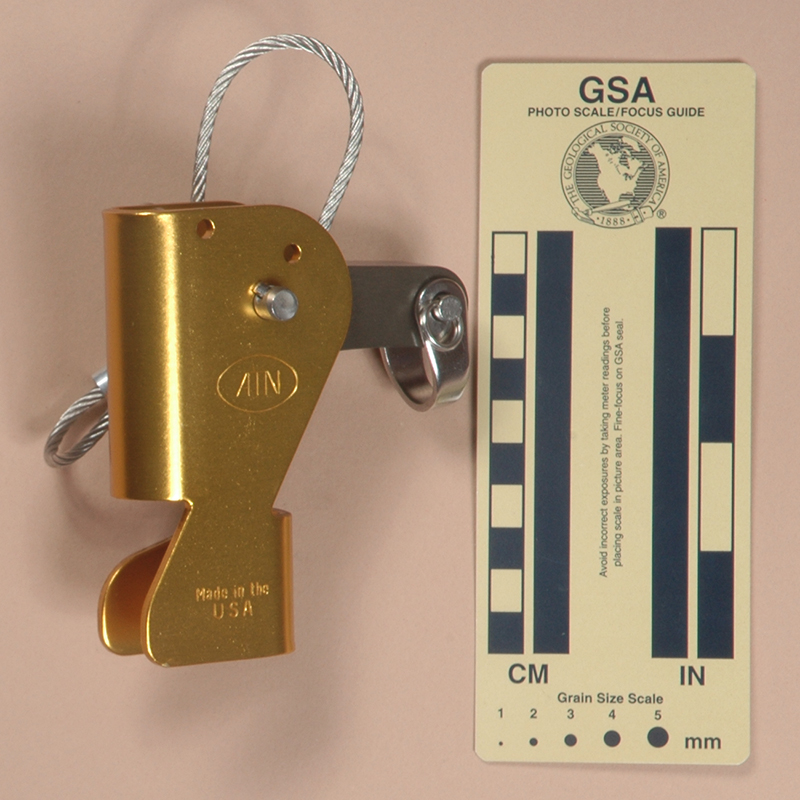
The ATN is 88 mm. tall, 90 mm. wide, 44 mm. thick, and weighs 219 g. The rope channel is 18 mm. wide. There is a diagonal slot below the cam and main rope channel, and a reversed rope channel below this.
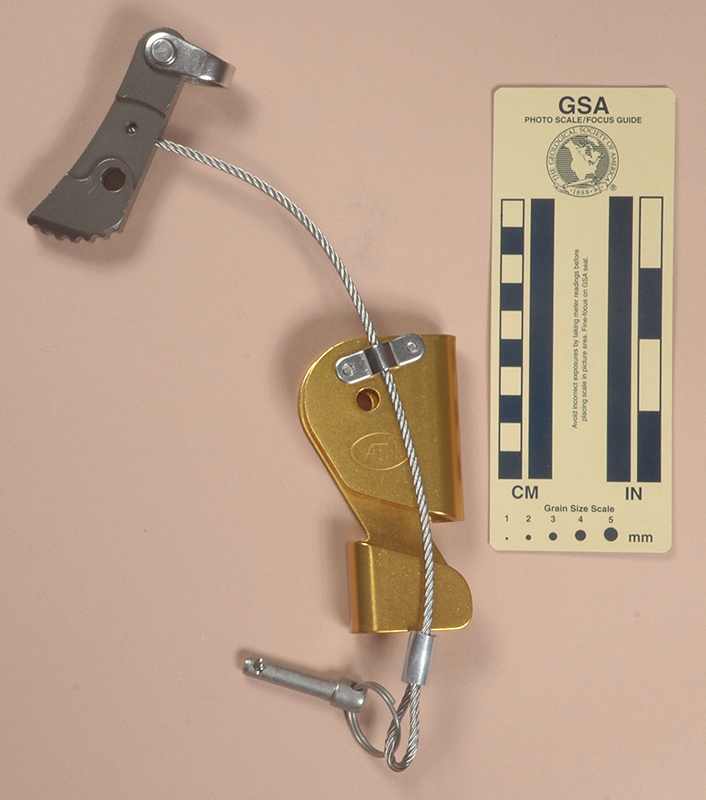
The cam is hard anodized aluminum alloy with a pivoting attachment stirrup pinned to the end, with the pin held in place with a small split ring. There are seven rounded teeth on the cam. The cam radius increases from 16 to 32 mm. over an angle of 70°, giving a 29° cam angle. The cam axle is a 7.8 mm. pin with a spring-loaded latch and a split ring on the head. The cam, axle, and shell are held together by a 3.1 mm. stainless steel cable attached to the cam by a set screw, to the shell by a plate and two round-head hex screws, and crimped into a loop around the split ring.
Each side is stamped with "ATN" inside an ellipse. One side is also stamped "Made in the USA."
The unusual shell appears to be designed to limit rotation leading to lost motion, but this will only work effectively if the rope below the ascender is taut. It would have been more effective to extend the rope channel above the cam rather than adding a reversed channel below.
The cam axle is NOT a quick-release pin, nor is it a pull pin with a retaining ball. It has a positive latch that is rather difficult to release - cavers would not like it in heavy mud.
As I mentioned, I acquired nine additional ascender bodies. These were of two types. Neither version was stamped with "Made in the USA." but one version had "Made in the USA." printed. Here is a picture showing the three body marking variations:

[ Top | Version A | Return to L.C. Ascenders ]
|
|
 |
| Front | Rear |
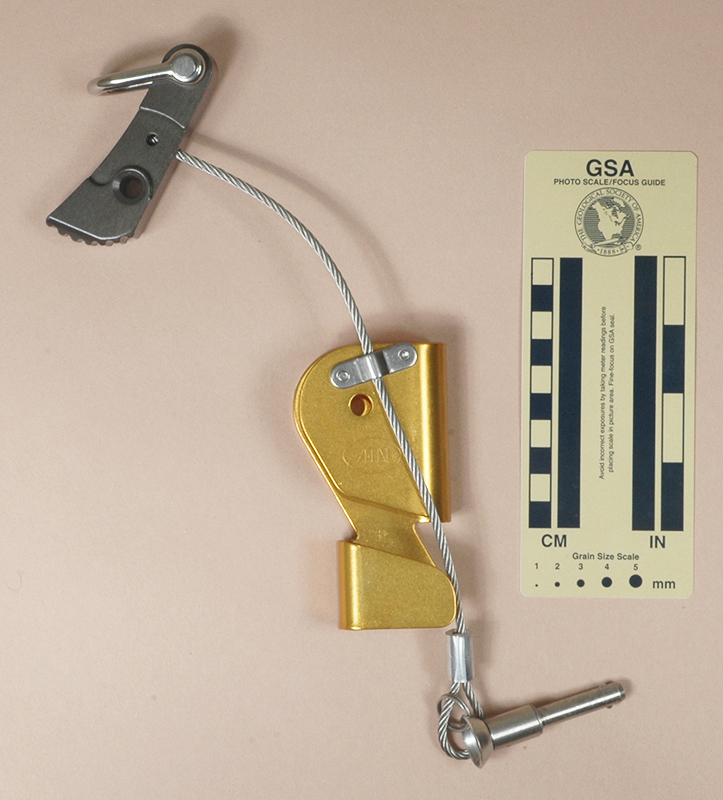 |
| Open for Rigging |
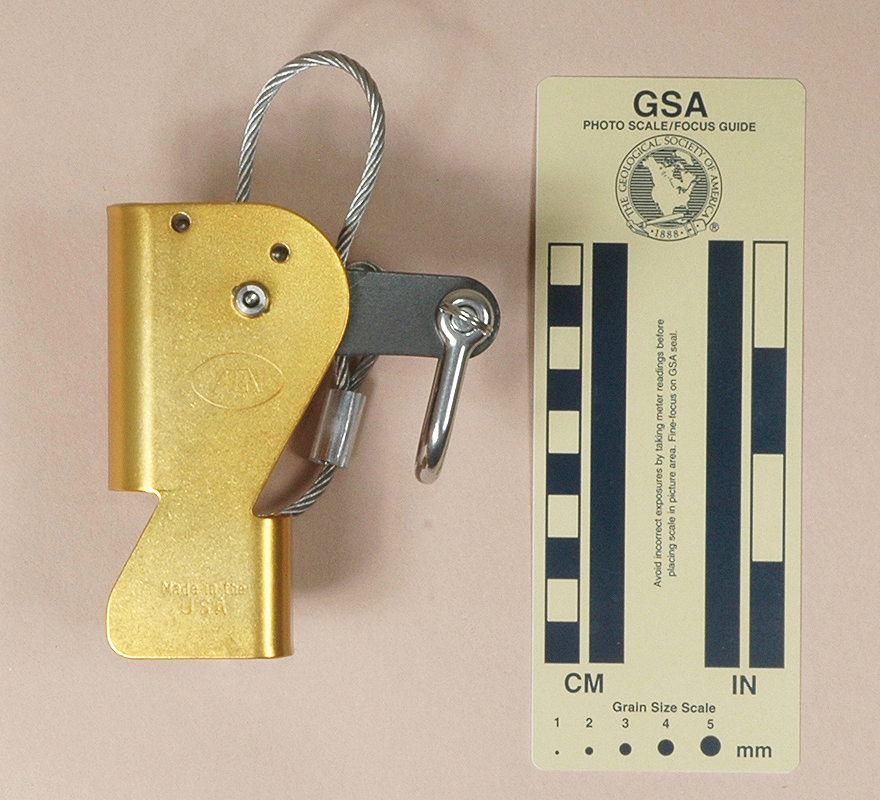
I acquired my ATN, Version B in 2017 as part of Bob Thrun’s collection.
The ATN, Version B is 88 mm. tall, 90 mm. wide, 44 mm. thick, and weighs 239 g.
Each side is stamped with "ATN" inside an ellipse. One side is also stamped "Made in the USA."
I was tempted to replace the shell with one of the variations mentioned earlier, but when I noticed that the clevis on this one was different than on Version A I decided to leave it alone.
[ Top | Version A | Version B ]