This page will not fit into a tiny viewport. Please choose a full-size monitor with a full-width window or select the abridged New Wave pages.


|
|
 |
| Front | Rear |
 |
| Open for Rigging |
I acquired my Varnedoe from Bill Varnedoe in 2000.
The Varnedoe is 112 mm. tall, 79 mm. wide, 57 mm. thick, and weighs 545 g. The cam is taken from a cable puller, and is mounted between two hand-cut aluminum side plates The anvil is also hand-cut. The assembly is held together by two bolts. A bight of 1/8" (3.2 mm.) steel cable is looped through the cam eye and the ends pass through holes in the anvil and are crimped together on the other side.
Bill Varnedoe made this ascender in the 1960s. Bill tied his foot slings directly to the cable. Bill used two of these ascenders to climb out of Natural Well, and the cable on one of them broke. As Bill describes it:
The wire wore at the point it entered the ascender, presumably from flexing, as load was applied and removed in ascending. I used 3/8 BlueWater to attach it to my stirrups. I had two of these as ascenders and a Jumar as a third attachment to the standing line for a safety. (The Jumar went to my seat harness.)
This ascender remained a curiosity for years, and I wondered why it was designed this way. It turns out that Bill was concerned with ascenders slipping. Bill wrote two articles in the Huntsville Grotto News that provided some historical insight[3 4]. In the first, Bill proposed the interesting idea that "a good ascender is best designed by a relatively inexperienced vertical engineer," justifying the idea by the fact that it worked for designing the Saturn V rocket.
Bill then analyzed how ascender cams worked, and realized that "the device with the largest squeeze force is the best rope gripper. He then looked at the Jumar and Gibbs and how they generated their "squeeze force." He then decided that he wanted more.
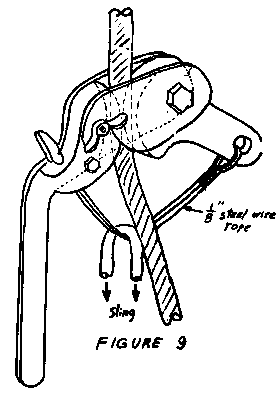
Bill’s second article focused on developing an ascender with a larger squeeze force. Inspired by how well pliers squeeze things, he patterned his first design after a nutcracker. He named his creation "VACUM," for "Vertical Assist Climb Up Machine." For you non-engineers, one always creates the acronym and then tries to find words that fit; it is never done the other way around. The resulting ascender was shown in his Figure 9. It achieved its design goal, with a squeeze force four times the user’s weight. Field tests found a problem. Alas, Bill encountered the Ultimate Rule of Engineering: Everything is Compromise. By focusing on achieving a high squeeze force, which he achieved admirably, he created an ascender that was difficult to release. Even the weight of his unloaded slings were enough to lock the ascender securely onto the rope.
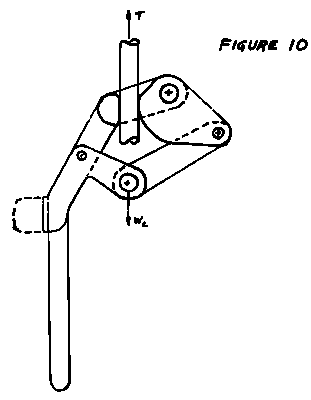
Bill tried replacing the cable with rigid links, creating VACUM II. A thumb tab on one of the links provides a positive release by using the thumb on the hand holding the handle. Bill’s description is brief, and I refer the interested reader to the original articles for puzzling things out on their own.
I don't know what happened to VACUM II, but it seems that what I have is a remnant of VACUM I with the handle cut off. Holding my ascender while pouring over Bill’s articles should make for a fascinating few hours for any true vertical gear nerd, should any such person exist.
Bill Varnedoe was a caver from Huntsville Alabama. In 1965 he invented and published the V-knot, a semi mechanical substitute for the Prusik made from a common snap hook.[1] Two years later he published an analysis showing that electric ascenders could be feasible.[2] He went through several iterations developing his VACUM ascender, publishing his work in 1970.[3][4]