

This page will not fit into a tiny viewport. Please choose a full-size monitor with a full-width window or select the abridged New Wave pages.

Version A
Version B

Version C
Version D

Version E

Version F

Version G

Version H

Version I

Version J

Version K
Version L

Version M

Version N

Version O

Version P

Version Q

Version R

Version R
|
|
|
|
|
|
| Version A | Version B | Version C | Version D | Version E |
|
|
|
|
|
|
| Version F | Version G | Version H | Version I | Version J |
|
|
|
|
|
|
| Version K | Version L | Version M | Version N | Version O |
|
|
|
|
|
| Version P |  Version Q |
Version R | Version S |
Peter Gibbs wrote the following in his company history:[1]
Vertical spelunking can be cold, wet, and extremely exhausting. Often the cave explorer is forced to rappel down a waterfall to get into a pit and then to ascend the rope, getting soaked and risking hypothermia. Early cavers used Prusik knots, inefficient, muscularly taxing knots that don’t hold well on wet rope.
In 1965 my brother, Charles, showed me a mechanical ascender he had built. I set out to manufacture it. I built 65 ascenders and sold a few of them to friends for places like Neff’s Cave.
That fall, at the National Speleological Society convention in Lovell, Wyoming, Charles entered a rope climbing contest. Using the newly minted Gibbs Ascenders, he cut the record time in half. I sold out that afternoon. Word spread rapidly and orders began coming in, but it was a very small market.
George Lowe, well known mountain climber and fellow physics student at the University of Utah, started using Gibbs Ascenders on his expeditions and writing them up in climbing magazine articles because they held well on ice cover ropes and were easy on the rope. That spread word around the world and opened up a second, larger market.
The cam in the first model Gibbs Ascender swung freely. Rock climbers wanted it spring loaded. Thus the second model was born.
Soon mountain rescue crews were using them for raising litters and ski resorts were using them to extract customers from stalled lifts. For their use, I added a stainless steel model and thicker aluminum model. And to give them more holding power, I put indents in the shell of the ascender.
Fire departments and rescue crews often use ropes more than half an inch thick so I added three quarter inch models next.
Over time Gibbs Ascenders found many niches to fill besides ascending ropes, including setting up rigging for rock concerts and protecting tree trimmers. There have been many modifications for specific markets but the basic design remains unchanged.
Here is a quick summary of the versions in my collection (all have anodized aluminum shells unless otherwise noted):
[ Top
| Version B
| Version C
| Version D
| Version E
| Version F
| Version G
| Version H
| Version I
| Version J
]
[ Version K
| Version L
| Version M
| Version N
| Version O
| Version P
| Version Q
| Version R
| Version S
| Return to L.C. Ascenders
]
|
|
 |
| Front | Side |
 |
| Open for Rigging |
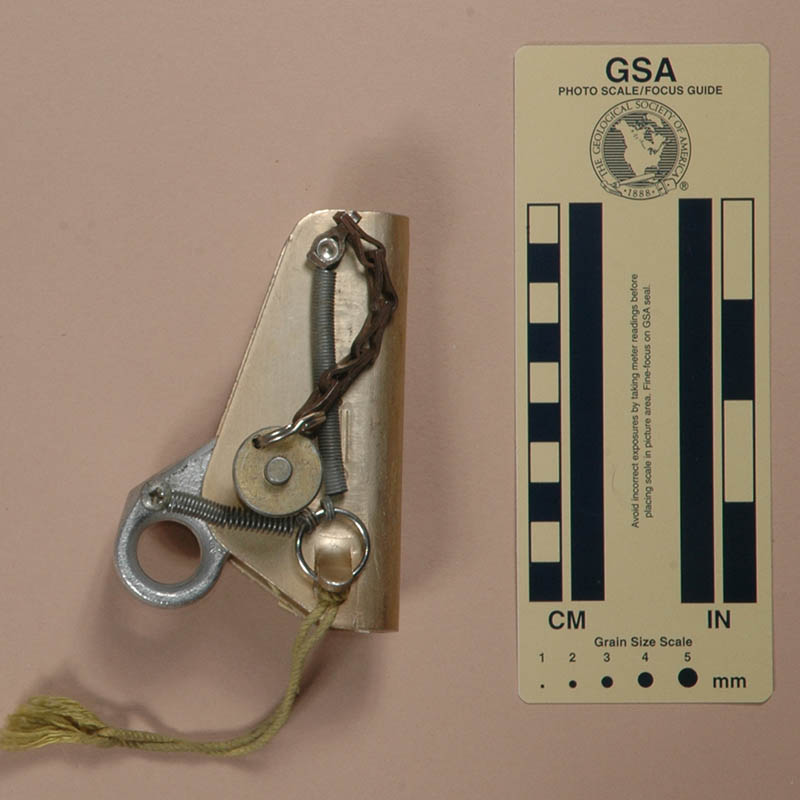
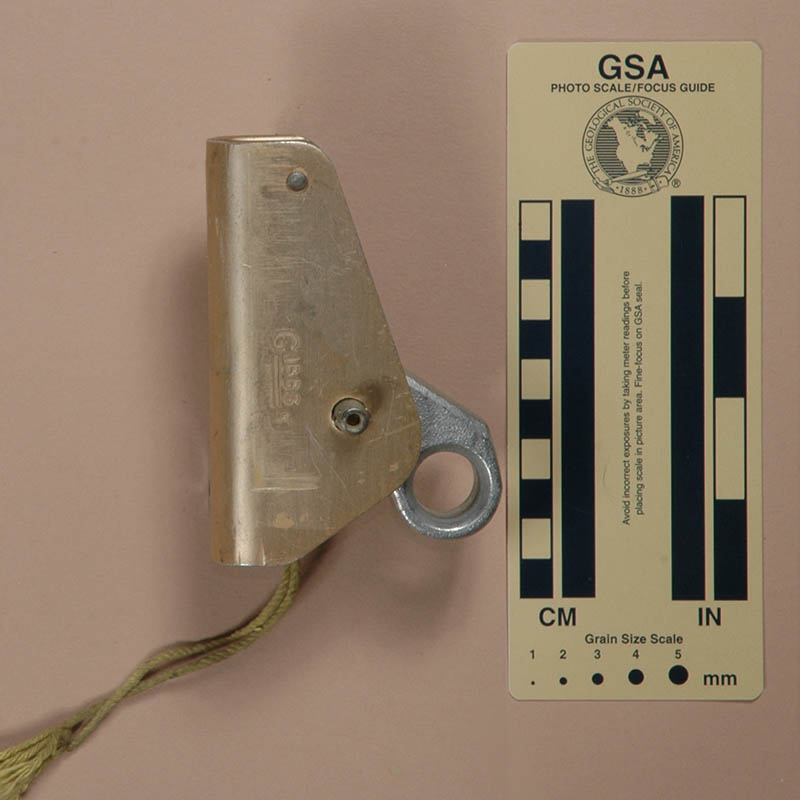
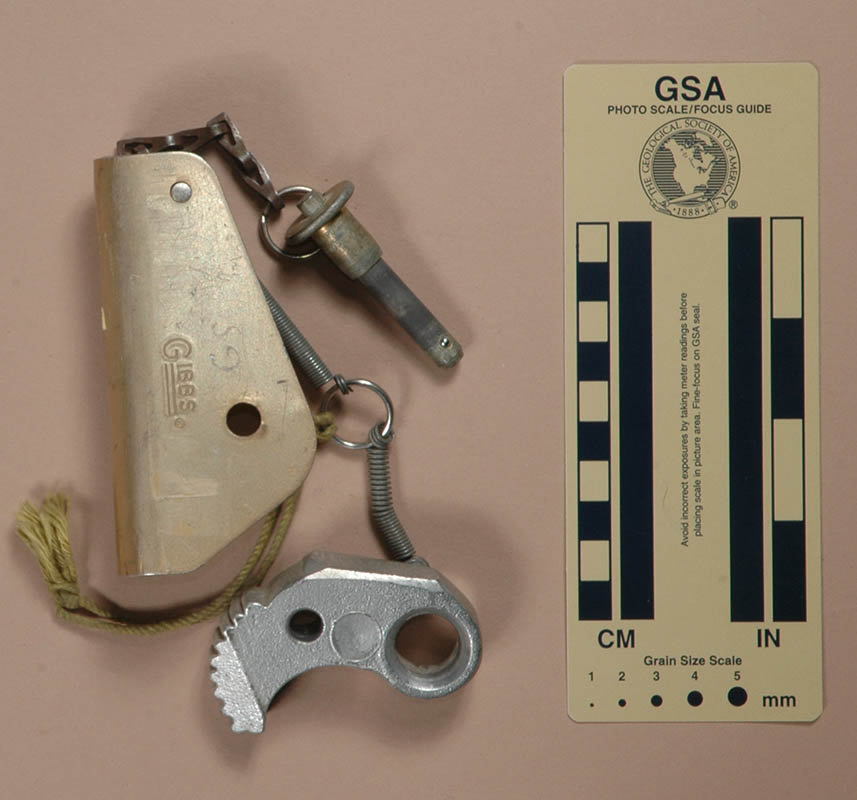
 I acquired a pair of these in the early 1970s, but I don't have a record of where or from whom I acquired them. I bought another pair at the 2012 NSS Convention Consignment Sales. I acquired another in 2017 as part of Bob Thrun’s collection.
Version A is 104 mm. tall, 71 mm. wide, 57 mm. thick, and weighs 186 g.
The shell is made from 1/8" (3.2 mm.) aluminum alloy bent to form a 17 mm. wide U-shaped rope channel.
The cam is cast aluminum. The cam radius increases from 16 to 33 mm. over an angle of 85°, giving a 27° cam angle. There are nine teeth, and the cam toe is tapered so that the end teeth are narrower. A 7.8 mm. diameter quick release pin acts as the cam axle.
This ascender has two springs connected by a split ring. One spring runs from a machine screw set in the cam to the split ring. When the split ring is placed over a "hook" forged out of the shell, it pulls the cam closed. The second spring pulls the split ring upward, which is necessary to keep the split ring on the hook because the hook is not aimed in the proper direction to resist the pull from the cam.
This ascender uses a chain as the quick release pin keeper.
Each side of the shell is stamped with "GIBBS" with a double underline. The QR pin is stamped "AVIBANK PUSH" and "BLS5B 10S."
This is the earliest spring-loaded Gibbs in my collection. It is the ascender shown in U.S. Patent #4,253,218.
[ Top
| Version A
| Version C
| Version D
| Version E
| Version F
| Version G
| Version H
| Version I
| Version J
]
[ Version K
| Version L
| Version M
| Version N
| Version O
| Version P
| Version Q
| Version R
| Version S
| Return to L.C. Ascenders
]
|
|
 |
| Front | Rear |
 |
| Open for Rigging |
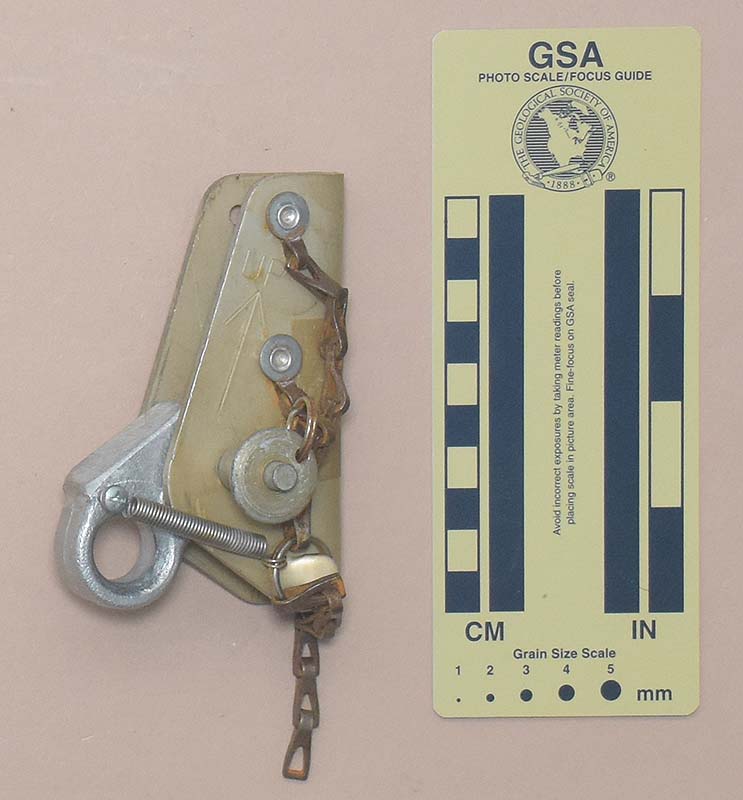
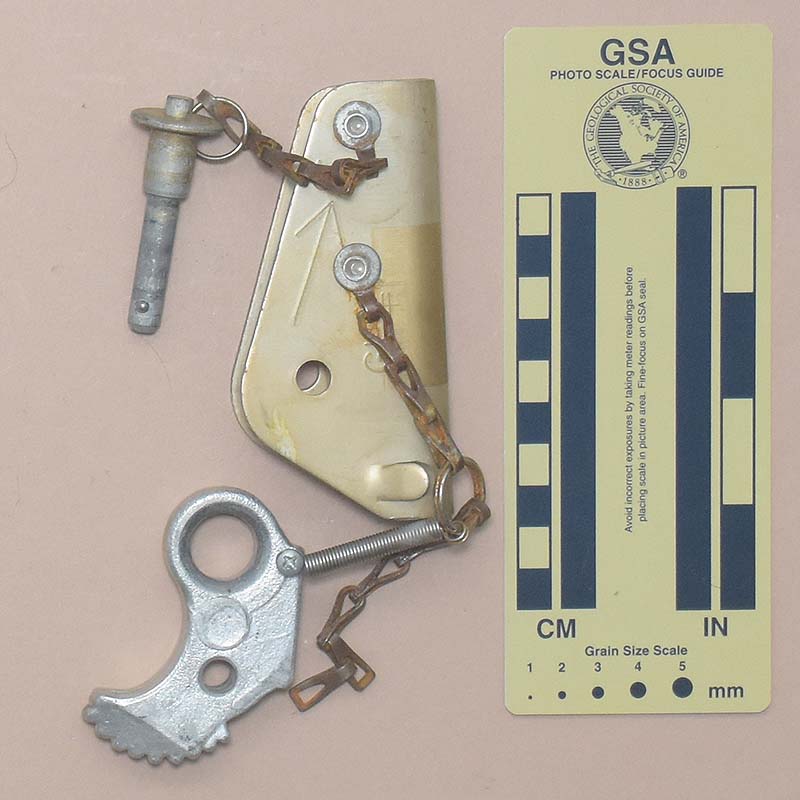
I acquired Version B from Barton Glasser in 2022.
Version C is 103 mm. tall, 71 mm. wide, 57 mm. thick, and weighs 192 g.
The shell is made from 1/8" (3.2 mm.) aluminum alloy bent to form a 17 mm. wide U-shaped rope channel.
The cam is cast aluminum. The cam radius increases from 14 to 33 mm. over an angle of 89°, giving a 28° cam angle. There are nine teeth, and the cam toe is tapered so that the end teeth are narrower. A 7.8 mm. diameter quick release pin acts as the cam axle.
A coil spring attaches to the cam by a Phillips head machine screw. The other end of the spring is attached to a split ring that can loop over a hook forged outward from the shell. One chain keeper attaches the quick release pin to the top of the shell, a second attaches the split ring to the midpoint of the shell (thereby indirectly attaching the cam), and a third chain acts as a pull for the split ring.
Each side of the shell is stamped with "UP," an up-pointing arrow, and "GIBBS" with a double underline. The QR pin is stamped "AVIBANK PUSH" and "BLS5810S."
Gibbs turned the hook so that it would resist the pull from the spring to the cam. This eliminated the need for a second spring.
The cams on Versions A through H all have the same shape. Some of these have hardcoated cams. The hard cams wear much better than the unfinished cams.
[ Top
| Version A
| Version B
| Version D
| Version E
| Version F
| Version G
| Version H
| Version I
| Version J
]
[ Version K
| Version L
| Version M
| Version N
| Version O
| Version P
| Version Q
| Version R
| Version S
| Return to L.C. Ascenders
]
|
|
 |
| Front | Rear |
 |
| Open for Rigging |
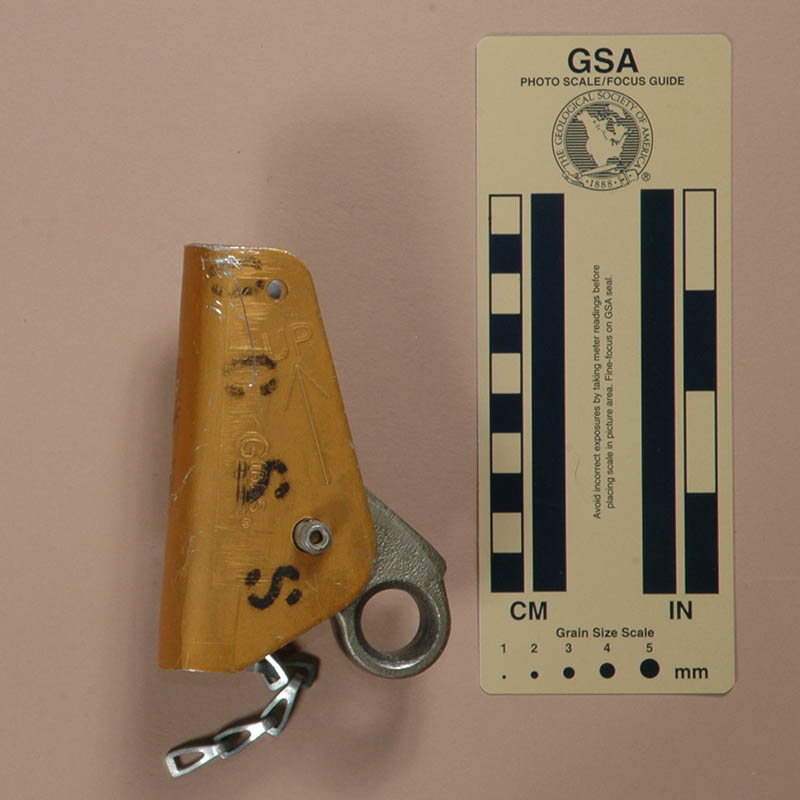
I acquired Version C used on eBay from Gene Clinger in 2008.
Version C is 104 mm. tall, 71 mm. wide, 57 mm. thick, and weighs 189 g.
The shell is made from 1/8" (3.2 mm.) aluminum alloy bent to form a 17 mm. wide U-shaped rope channel.
The cam is hard anodized cast aluminum. The cam radius increases from 16 to 33 mm. over an angle of 85°, giving a 27° cam angle. There are nine teeth, and the cam toe is tapered so that the end teeth are narrower. A 7.8 mm. diameter quick release pin acts as the cam axle.
A coil spring attaches to the cam by a Phillips head machine screw. The other end of the spring is attached to a split ring that can loop over a hook forged outward from the shell. One chain keeper attaches the quick release pin to the top of the shell, a second attaches the split ring to the midpoint of the shell (thereby indirectly attaching the cam), and a third chain acts as a pull for the split ring.
Each side of the shell is stamped with "UP," an up-pointing arrow, and "GIBBS" with a double underline. The QR pin is stamped "AVIBANK PUSH" and "55207."
Version C is similar to Version B, but has a hardcoated cam.
[ Top
| Version A
| Version B
| Version C
| Version E
| Version F
| Version G
| Version H
| Version I
| Version J
]
[ Version K
| Version L
| Version M
| Version N
| Version O
| Version P
| Version Q
| Version R
| Version S
| Return to L.C. Ascenders
]
|
|
 |
| Front | Side |
 |
| Open for Rigging |
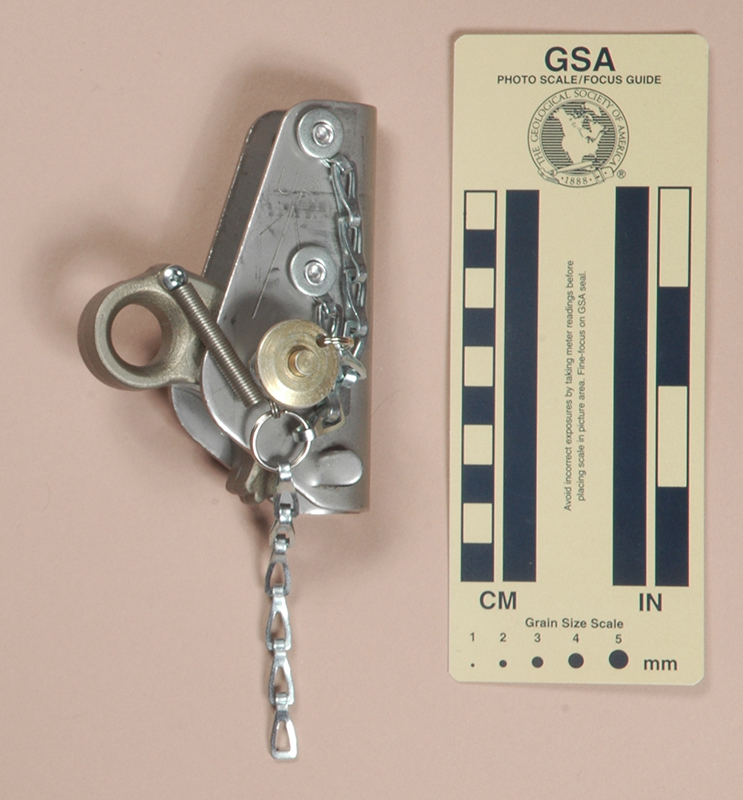
I acquired Version D from Carol Jo Rushin-Elron at the 2016 NSS Convention.
Version D is 104 mm. tall, 70 mm. wide, 57 mm. thick, and weighs 293 g.
The shell is made from 2.7 mm. stainless steel bent to form a 17 mm. wide U-shaped rope channel.
The cam is hard anodized cast aluminum. The cam radius increases from 16 to 33 mm. over an angle of 85°, giving a 27° cam angle. There are nine teeth, and the cam toe is tapered so that the end teeth are narrower. A 7.8 mm. diameter quick release pin acts as the cam axle.
A coil spring attaches to the cam by a Phillips head machine screw. The other end of the spring is attached to a split ring that can loop over a hook forged outward from the shell. One chain keeper attaches the quick release pin to the top of the shell, a second attaches the split ring to the midpoint of the shell (thereby indirectly attaching the cam), and a third chain acts as a pull for the split ring.
Each side of the shell is stamped with "UP," an up-pointing arrow, and "GIBBS" with a double underline. The QR pin is stamped "AVIBANK PUSH" and "55207."
The stainless steel shell serves no useful purpose for normal caving, and adds unnecessary weight.
[ Top
| Version A
| Version B
| Version C
| Version D
| Version F
| Version G
| Version H
| Version I
| Version J
]
[ Version K
| Version L
| Version M
| Version N
| Version O
| Version P
| Version Q
| Version R
| Version S
| Return to L.C. Ascenders
]
|
|
 |
| Front | Rear |
 |
| Open for Rigging |
 I don't have a record of where or from whom I acquired my Version E, but I assume that it was in the 1970s. I acquired a second one used on eBay from Gene Clinger in 2008. I obtained two more on eBay from Lynn Troutman in 2025.
Version E is 104 mm. tall, 72 mm. wide, 57 mm. thick, and weighs 197 g.
The shell is made from 1/8" (3.2 mm.) aluminum alloy bent to form a 17 mm. wide U-shaped rope channel.
The cam is cast aluminum. The cam radius increases from 16 to 33 mm. over an angle of 85°, giving a 27° cam angle. There are nine teeth, and the cam toe is tapered so that the end teeth are narrower. A 7.8 mm. diameter quick release pin acts as the cam axle.
A coil spring attaches to the cam by a Phillips head machine screw. The other end of the spring is attached to a split ring that can loop over a hook forged outward from the shell. One chain keeper attaches the quick release pin to the top of the shell, a second attaches the split ring to the midpoint of the shell (thereby indirectly attaching the cam), and a third chain acts as a pull for the split ring.
Each side of the shell is stamped with "UP," an up-pointing arrow, and "GIBBS" with a double underline. The QR pin is stamped "AVIBANK PUSH" and "BLS5B10S."
The chain keeper for the Quick Release pin is now hooked through the chain to the split ring.
[ Top
| Version A
| Version B
| Version C
| Version D
| Version E
| Version G
| Version H
| Version I
| Version J
]
[ Version K
| Version L
| Version M
| Version N
| Version O
| Version P
| Version Q
| Version R
| Version S
| Return to L.C. Ascenders
]
|
|
 |
| Front | Rear |
 |
| Open for Rigging |
I acquired my Gibbs QR Spring Loaded, Version F in 2017 as part of Bob Thrun’s collection.
Version F is 103 mm. tall, 71 mm. wide, 57 mm. thick, and weighs 192 g.
Version F has a hardcoated cam and copper-plated keeper chains.
Each side of the shell is stamped with "UP," an up-pointing arrow, and "GIBBS" with a double underline. The QR pin is stamped "AVIBANK PUSH" and "BLS5B10S."
Gibbs ascenders start to slip when the cam wears down to about the seventh tooth. The hard coated cam will last much longer than the uncoated cams. I still prefer to cut the two largest teeth (#1 and #2) off my Gibbs because they do create noticeable drag, especially on a foot cam at the bottom of a pit. I don't climb on oversize ropes, and these teeth serve no useful purpose on thinner ones.
[ Top
| Version A
| Version B
| Version C
| Version D
| Version E
| Version F
| Version H
| Version I
| Version J
]
[ Version K
| Version L
| Version M
| Version N
| Version O
| Version P
| Version Q
| Version R
| Version S
| Return to L.C. Ascenders
]
|
|
 |
| Front | Rear |
 |
| Open for Rigging |
I acquired my Gibbs QR Spring Loaded, Version G in 2017 as part of Bob Thrun’s collection.
Version G is 103 mm. tall, 72 mm. wide, 57 mm. thick, and weighs 179 g.
This version eliminates the coil spring and replaces it with a new design. A wire spring attaches to the cam by a Phillips head machine screw. The other end of the spring wraps once around the QR pin and then is secured to the shell with a second Phillips head machine screw and two star lock washers.
Each side of the shell is stamped with "UP," an up-pointing arrow, and "GIBBS" with a double underline. The QR pin is stamped "AVIBANK" and "55207."The first big improvement in the spring-loaded Gibbs was the introduction of the wire spring. The early models did not have a housing, and it was easy to damage the spring in rough caving conditions. I like the new spring design better than the old one, but putting it on an old shell leaves a nonfunctional tab that tends to catch on things when it shouldn't. If I were to use this ascender regularly, I would flatten the tab.
[ Top
| Version A
| Version B
| Version C
| Version D
| Version E
| Version F
| Version G
| Version I
| Version J
]
[ Version K
| Version L
| Version M
| Version N
| Version O
| Version P
| Version Q
| Version R
| Version S
| Return to L.C. Ascenders
]
|
|
 |
| Front | Rear |
 |
| Open for Rigging |
I don't have a record of where or from whom I acquired my Version H.
Version H is 104 mm. tall, 70 mm. wide, 57 mm. thick, and weighs 182 g.
The shell is made from 1/8" (3.2 mm.) aluminum alloy bent to form a 17 mm. wide U-shaped rope channel.
The cam is hard anodized cast aluminum. The cam radius increases from 16 to 33 mm. over an angle of 85°, giving a 27° cam angle. There are nine teeth, and the cam toe is tapered so that the end teeth are narrower. A 7.8 mm. diameter quick release pin acts as the cam axle. The pin retainer is a short chain secured to the shell with a Phillips head machine screw and star lock washer.
A wire spring attaches to the cam by a 0hillips head machine screw. The other end of the spring wraps once around the QR pin and then is secured to the shell with a second Phillips head machine screw and star lock washer.
Each side of the shell is stamped with "UP," an up-pointing arrow, and "GIBBS" with a double underline. The QR pin is stamped "AVIBANK 55207."
This version eliminated the shell tab for the old coil spring. This ascender still uses a chain as a quick release pin retainer.
[ Top
| Version A
| Version B
| Version C
| Version D
| Version E
| Version F
| Version G
| Version H
| Version J
]
[ Version K
| Version L
| Version M
| Version N
| Version O
| Version P
| Version Q
| Version R
| Version S
| Return to L.C. Ascenders
]
|
|
 |
| Front | Side |
 |
| Open for Rigging |
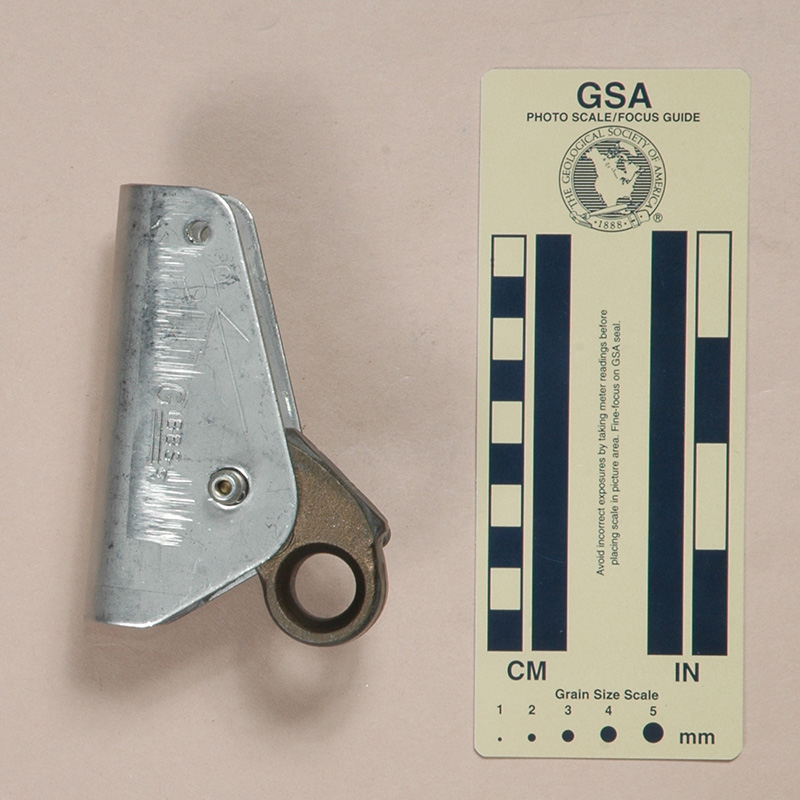
I acquired my Gibbs QR Spring Loaded, Version I from Speleoshoppe in 2012 as new old stock.
Version I is 104 mm. tall, 71 mm. wide, 57 mm. thick, and weighs 297 g.
The shell is made from 2.9 mm. stainless steel sheet bent to form a 16 mm. wide U-shaped rope channel.
The cam is hard anodized cast aluminum. The cam radius increases from 16 to 34 mm. over an angle of 86°, giving a 26° cam angle. There are nine teeth, and the cam toe is tapered so that the end teeth are narrower. A 7.8 mm. diameter quick release pin acts as the cam axle. The pin retainer is a short chain secured to the shell with a Phillips head machine screw and star lock washer.
A wire spring attaches to the cam by a 0hillips head machine screw. The other end of the spring wraps once around the QR pin and then is secured to the shell with a second Phillips head machine screw and star lock washer.
Each side of the shell is stamped with "UP," an up-pointing arrow, and "GIBBS" with a double underline. The QR pin is stamped "AVIBANK 55207."
The stainless steel shell serves no useful purpose for normal caving, and adds unnecessary weight.
[ Top
| Version A
| Version B
| Version C
| Version D
| Version E
| Version F
| Version G
| Version H
| Version I
]
[ Version K
| Version L
| Version M
| Version N
| Version O
| Version P
| Version Q
| Version R
| Version S
| Return to L.C. Ascenders
]
|
|
 |
| Front | Side |
 |
| Open for Rigging |
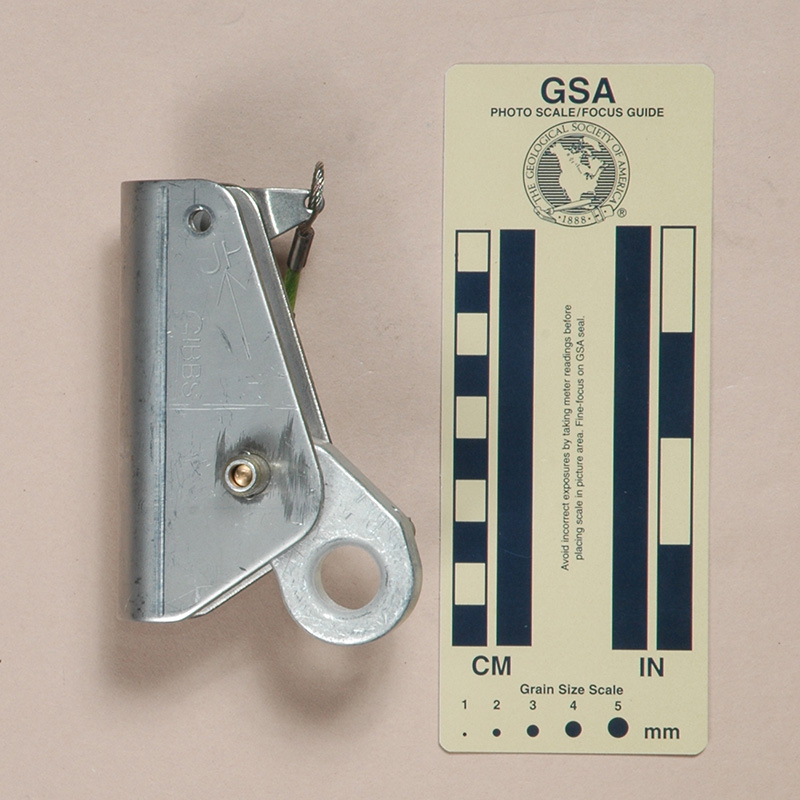
I acquired one Gibbs QR Spring Loaded, Version J from Speleoshoppe in 2012 as new old stock. Mike Gerbman gave me another one in 2025
Version J is 104 mm. tall, 71 mm. wide, 63 mm. thick, and weighs 334 g. The rope channel is 17 mm. wide.
The cam is forged from 2024-T6 aluminum plate. The cam radius increases from 15 to 32 mm. over an angle of 82°, giving a 27° cam angle. There are nine teeth, and the cam toe is tapered so that the end teeth are narrower. A 9.5 mm. diameter quick release pin acts as the cam axle. The pin keeper is a piece of 1.6 mm. steel cable with eye loops crimped at each end and a short (13 mm.) plastic covered central section. One eye passes through a hole in the pin, the other attaches to a teardrop shaped aluminum tab riveted to the shell.
A wire spring attaches to the cam by a 0hillips head machine screw. The other end of the spring wraps once around the QR pin and then is secured to the shell with a rivet and washer. A second rivet with two washers does not serve a clear purpose, but may be intended to help align the spring.
Each side of the shell is stamped with "UP," an up-pointing arrow, and "GIBBS" with a double underline. The QR pin is stamped "AVIBANK PUSH" and "BLS6B11S." The cam is printed with "HT2375A," CAM," "2024-T6," "C/F," and a small circle with "CF" and "11" inside.
The new cam does not have the hard coating that the cast cams had.
The stainless steel shell serves no useful purpose for normal caving, and adds unnecessary weight. The QR pin is larger as well.
I don't like the cable keeper since it is rather stiff and seems to resist aligning the quick release pin, but attached to the top of the shell, it is not as bad as on the versions where the attachment is closer to the QR pin.
[ Top
| Version A
| Version B
| Version C
| Version D
| Version E
| Version F
| Version G
| Version H
| Version I
| Version J
]
[ Version L
| Version M
| Version N
| Version O
| Version P
| Version Q
| Version R
| Version S
| Return to L.C. Ascenders
]
|
|
 |
| Front | Side |
 |
| Open for Rigging |
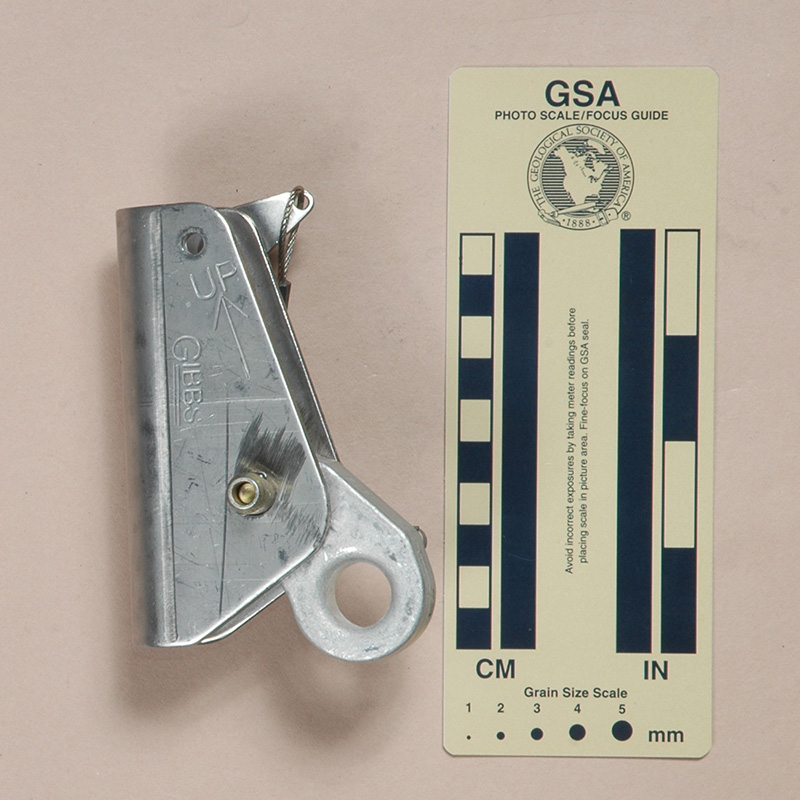
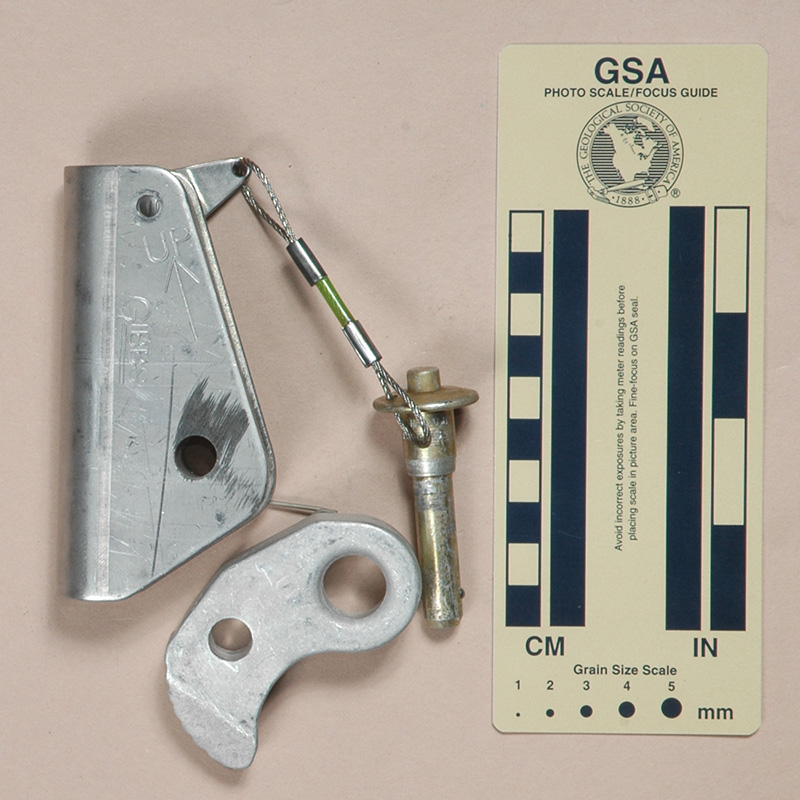
I acquired my Gibbs QR Spring Loaded, Version K from Speleoshoppe in 2012 as new old stock.
This version is 107 mm. tall, 71 mm. wide, 69 mm. thick, and weighs 337 g. The rope channel is 17 mm. wide.
Version K is essentially identical to Version J, except there is no washer holding the teardrop on.
Each side of the shell is stamped with "UP," an up-pointing arrow, and "GIBBS" with a double underline. The QR pin is stamped "AVIBANK PUSH" and "BLS6B11S." The cam is printed with "HT237" (likely "HT2375A," but the axle hole cuts off the lettering), "CAM," "2024-T6," "C/F," and a small circle with "CF" and "11" inside.
Still no hard coating, and still too heavy for my taste.
I don't like the cable keeper since it is rather stiff and seems to resist aligning the quick release pin, but attached to the top of the shell, it is not as bad as on the versions where the attachment is closer to the QR pin.
[ Top
| Version A
| Version B
| Version C
| Version D
| Version E
| Version F
| Version G
| Version H
| Version I
| Version J
]
[ Version K
| Version M
| Version N
| Version O
| Version P
| Version Q
| Version R
| Version S
| Return to L.C. Ascenders
]
|
|
 |
| Front | Rear |
 |
| Open for Rigging |
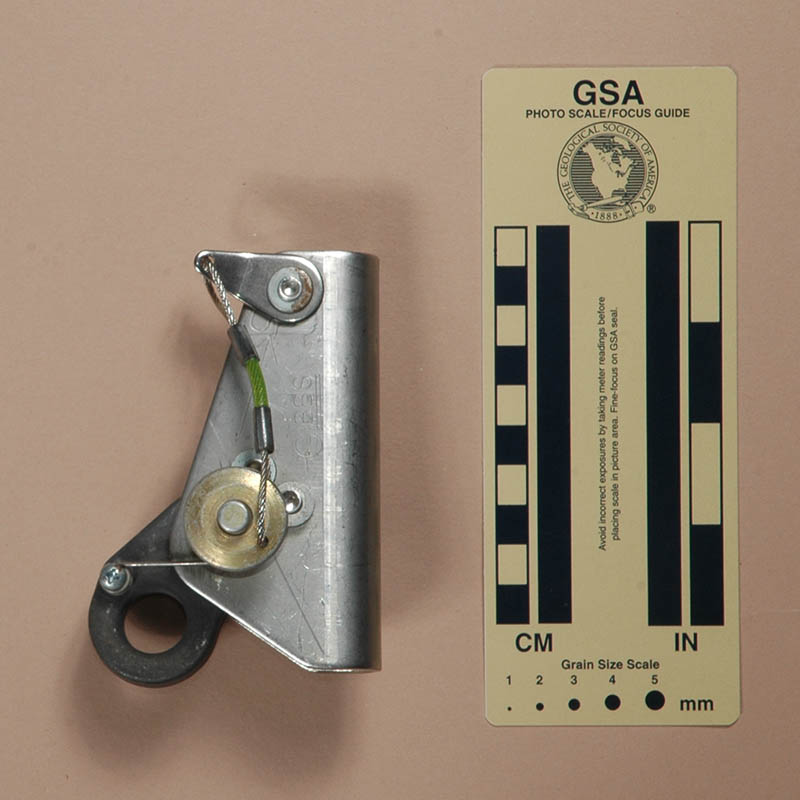
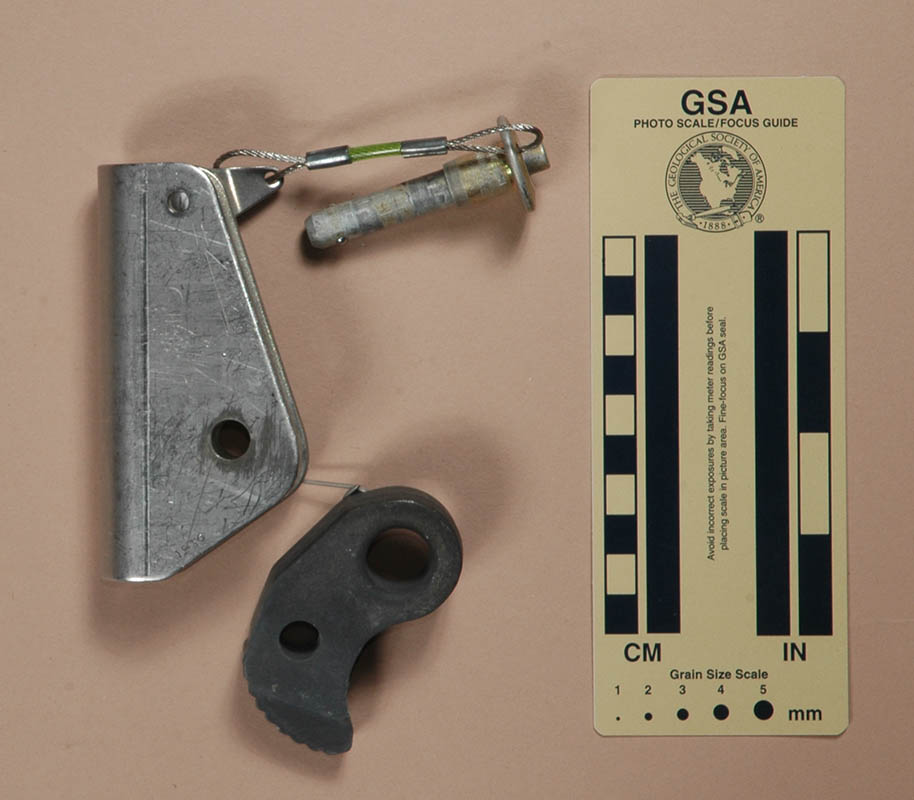
I acquired this Gibbs from Sheryle Bauer in 2009.
This version is 103 mm. tall, 72 mm. wide, 63 mm. thick, and weighs 337 g.
The shell is made from 1/8" (3.2 mm.) stainless steel bent to form a 17 mm. wide U-shaped rope channel.
The cam is hard anodized cast aluminum. The cam radius increases from 16 to 33 mm. over an angle of 85°, giving a 27° cam angle. There are nine teeth, and the cam toe is tapered so that the end teeth are narrower. A 9.4 mm. diameter quick release pin acts as the cam axle. The quick release pin keeper was changed to a 1.7 mm. stainless steel cable attached to a teardrop-shaped plate riveted to the shell. The plate did not quite fit, so the lower end needed to be sheared off.
A wire spring attaches to the cam by a 0hillips head machine screw. The other end of the spring wraps once around the QR pin and then is secured to the shell with a rivet and flat washer.
Each side of the shell is stamped with "UP," an up-pointing arrow, and "GIBBS" with a double underline. The QR pin is stamped "AVIBANK PUSH" and "BLS6B11S."
Version L has a stainless steel shell that accounts for the excessive weight. The QR pin is larger as well.
I don't like the cable keeper since it is rather stiff and seems to resist aligning the quick release pin.
[ Top
| Version A
| Version B
| Version C
| Version D
| Version E
| Version F
| Version G
| Version H
| Version I
| Version J
]
[ Version K
| Version L
| Version N
| Version O
| Version P
| Version Q
| Version R
| Version S
| Return to L.C. Ascenders
]
|
|
 |
| Front | Rear |
 |
| Open for Rigging |
I acquired two Version M ascenders used on eBay, one from Ronald Krieger in 2008 and another from Sheryle Bauer in 2009.
This version is 104 mm. tall, 70 mm. wide, 57 mm. thick, and weighs 180 g.
The shell is made from 1/8" (3.2 mm.) aluminum alloy bent to form a 17 mm. wide U-shaped rope channel.
The cam is hard anodized cast aluminum. The cam radius increases from 16 to 33 mm. over an angle of 85°, giving a 27° cam angle. There are nine teeth, and the cam toe is tapered so that the end teeth are narrower. A 7.8 mm. diameter quick release pin acts as the cam axle. The quick release pin keeper was changed to a 1.7 mm. stainless steel cable attached to a teardrop-shaped plate riveted to the shell. The plate did not quite fit, so the lower end needed to be sheared off.
A wire spring attaches to the cam by a 0hillips head machine screw. The other end of the spring wraps once around the QR pin and then is secured to the shell with a rivet and flat washer.
Each side of the shell is stamped with "UP," an up-pointing arrow, and "GIBBS" with a double underline. The QR pin is stamped "AVIBANK PUSH" and "55207."
I don't like the cable keeper since it is rather stiff and seems to resist aligning the quick release pin.
[ Top
| Version A
| Version B
| Version C
| Version D
| Version E
| Version F
| Version G
| Version H
| Version I
| Version J
]
[ Version K
| Version L
| Version M
| Version O
| Version P
| Version Q
| Version R
| Version S
| Return to L.C. Ascenders
]
|
|
 |
| Front | Rear |
 |
| Open for Rigging |
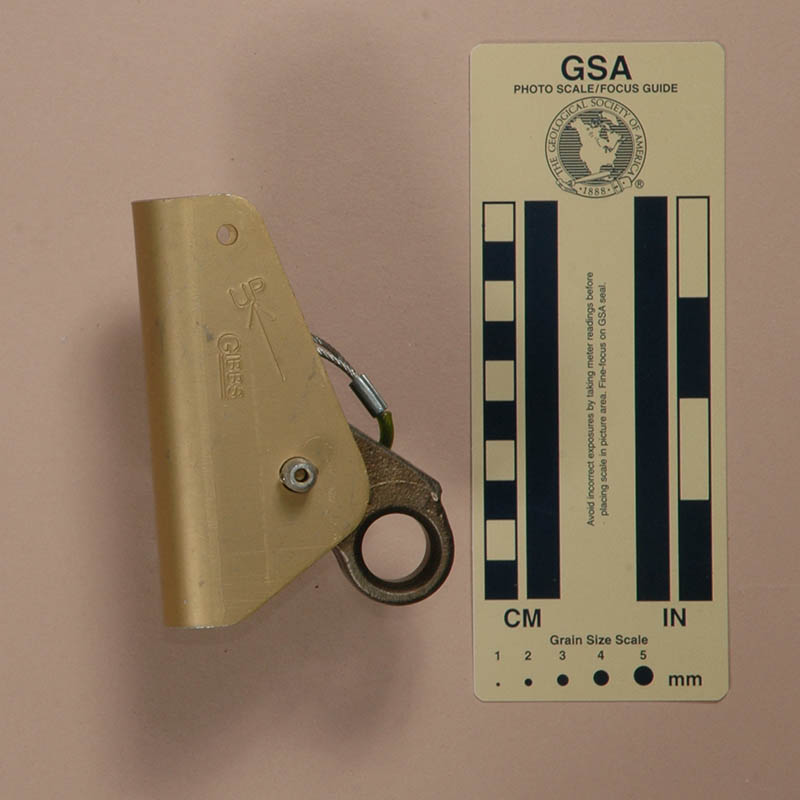
I acquired this Gibbs from John E. Weinel, Inc. in 1991.
This version is 104 mm. tall, 72 mm. wide, 65 mm. thick, and weighs 187 g.
The shell is made from 1/8" (3.2 mm.) aluminum alloy bent to form a 17 mm. wide U-shaped rope channel.
The cam is hard anodized cast aluminum. The cam radius increases from 16 to 33 mm. over an angle of 85°, giving a 27° cam angle. There are nine teeth, and the cam toe is tapered so that the end teeth are narrower. A 7.8 mm. diameter quick release pin acts as the cam axle. The quick release pin keeper is a 1.7 mm. stainless steel cable attached to a teardrop-shaped plate riveted to the spring cover.
A wire spring attaches to the cam by a 0hillips head machine screw. The other end of the spring goes under a black plastic spring housing riveted to the shell, wraps once around the QR pin and then hooks over one of the rivets holding the spring housing in place.
Each side of the shell is stamped with "UP," an up-pointing arrow, and "GIBBS" with a double underline. The QR pin is stamped "AVIBANK PUSH" and "BLS5B13S."
Gibbs added the plastic housing to protect the spring wire.
[ Top
| Version A
| Version B
| Version C
| Version D
| Version E
| Version F
| Version G
| Version H
| Version I
| Version J
]
[ Version K
| Version L
| Version M
| Version N
| Version P
| Version Q
| Version R
| Version S
| Return to L.C. Ascenders
]
|
|
 |
| Front | Rear |
 |
| Open for Rigging |
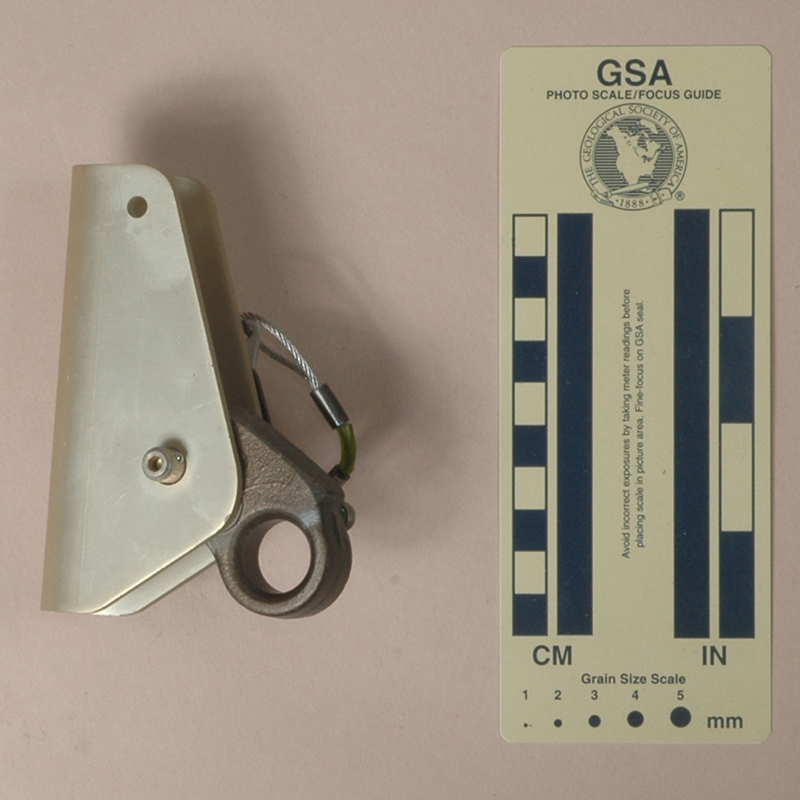
I acquired my Gibbs QR Spring Loaded, Version O in 2017 as part of Bob Thrun’s collection.
This version is 103 mm. tall, 72 mm. wide, 65 mm. thick, and weighs 187 g.
There are no markings on the shell. The QR pin is stamped "AVIBANK PUSH" and "BLS5B13S."
Somehow, this one escaped without the normal stampings on each side of the shell.
[ Top
| Version A
| Version B
| Version C
| Version D
| Version E
| Version F
| Version G
| Version H
| Version I
| Version J
]
[ Version K
| Version L
| Version M
| Version N
| Version O
| Version Q
| Version R
| Version S
| Return to L.C. Ascenders
]
|
|
 |
| Front | Rear |
 |
| Open for Rigging |
I acquired my Gibbs QR Spring Loaded, Version P from Robert Bowman in 2012.
The shell is made from 1/8" (3.2 mm.) aluminum alloy bent to form a 17 mm. wide U-shaped rope channel.
The cam is hard anodized cast aluminum. The cam radius increases from 16 to 33 mm. over an angle of 85°, giving a 27° cam angle. There are nine teeth, and the cam toe is tapered so that the end teeth are narrower. A 7.8 mm. diameter quick release pin acts as the cam axle. The quick release pin keeper is a 2 mm. nylon cord tied attached to a teardrop-shaped plate riveted to the spring cover.
A wire spring attaches to the cam by a 0hillips-head machine screw. The other end of the spring goes under a black plastic spring housing riveted to the shell, wraps once around the QR pin and then hooks over one of the rivets holding the spring housing in place.
Each side of the shell is stamped with "UP," an up-pointing arrow, and "GIBBS" with a double underline. The QR pin is stamped "AVIBANK PUSH" and "BLS5B13SL4A6."
The cord pin keeper is an improvement over the previous obnoxious cable keeper.
[ Top
| Version A
| Version B
| Version C
| Version D
| Version E
| Version F
| Version G
| Version H
| Version I
| Version J
]
[ Version K
| Version L
| Version M
| Version N
| Version O
| Version P
| Version R
| Version S
| Return to L.C. Ascenders
]
Version Q|
|
 |
| Front | Rear |
 |
| Open for Rigging |
I acquired my Gibbs QR Spring Loaded, Version Q from Robert Bowman in 2012.
The shell is made from 1/8" (3.2 mm.) aluminum alloy bent to form a 17 mm. wide U-shaped rope channel.
The cam is hard anodized cast aluminum. The cam radius increases from 16 to 33 mm. over an angle of 85°, giving a 27° cam angle. There are nine teeth, and the cam toe is tapered so that the end teeth are narrower. A 7.8 mm. diameter quick release pin acts as the cam axle. The quick release pin keeper is a 2 mm. nylon cord tied attached to a teardrop-shaped plate riveted to the spring cover.
A wire spring attaches to the cam by a 0hillips-head machine screw. The other end of the spring goes under a black plastic spring housing riveted to the shell, wraps once around the QR pin and then hooks over the end of a Phillips-head screw passing through the cover.
Each side of the shell is stamped with "UP," an up-pointing arrow, and "GIBBS" with a double underline. The QR pin is stamped "AVIBANK PUSH" and "BLS5B13SL4A6."
This version has a revised spring housing with a lower extension. By hooking the spring over a screw, Gibbs Products gives the user the option of removing the screw so that the spring can swing freely, effectively defeating the spring action, The lower extension on the housing provides space for the free end of the spring to rotate.
Version Q is a nice ascender, worthy of a star .
[ Top
| Version A
| Version B
| Version C
| Version D
| Version E
| Version F
| Version G
| Version H
| Version I
| Version J
]
[ Version K
| Version L
| Version M
| Version N
| Version O
| Version P
| Version Q
| Version S
| Return to L.C. Ascenders
]
|
|
 |
| Front | Rear |
 |
| Open for Rigging |
I acquired two QR Spring Loaded, Version R Gibbs from Robert Bowman in 2012.
The shell is made from 1/8" (3.2 mm.) aluminum alloy bent to form a 17 mm. wide U-shaped rope channel.
The cam is hard anodized cast aluminum. The cam radius increases from 16 to 33 mm. over an angle of 85°, giving a 27° cam angle. There are nine teeth, and the cam toe is tapered so that the end teeth are narrower. A 7.8 mm. diameter quick release pin acts as the cam axle. The quick release pin keeper is a bight of 1/2" (13 mm.) webbing riveted to the shell that passes through a split ring attached to the QR pin.
A wire spring attaches to the cam by a 0hillips-head machine screw. The other end of the spring goes under a black plastic spring housing riveted to the shell, wraps once around the QR pin and then hooks over the end of a Phillips-head screw passing through the cover.
Each side of the shell is stamped with "UP," an up-pointing arrow, and "GIBBS" with a double underline. The QR pin is stamped "AVIBANK 55207."
I prefer the cord keeper to the webbing keeper. Gibbs Products never found a good solution to the keeper problem. Cord and webbing keepers wear out, and stiff cable keepers are awkward to use.
[ Top
| Version A
| Version B
| Version C
| Version D
| Version E
| Version F
| Version G
| Version H
| Version I
| Version J
]
[ Version K
| Version L
| Version M
| Version N
| Version O
| Version P
| Version Q
| Version R
| Return to L.C. Ascenders
]
|
|
 |
 |
| Front | Rear | Gray Version |
 |
 |
| Side | Open for Rigging |
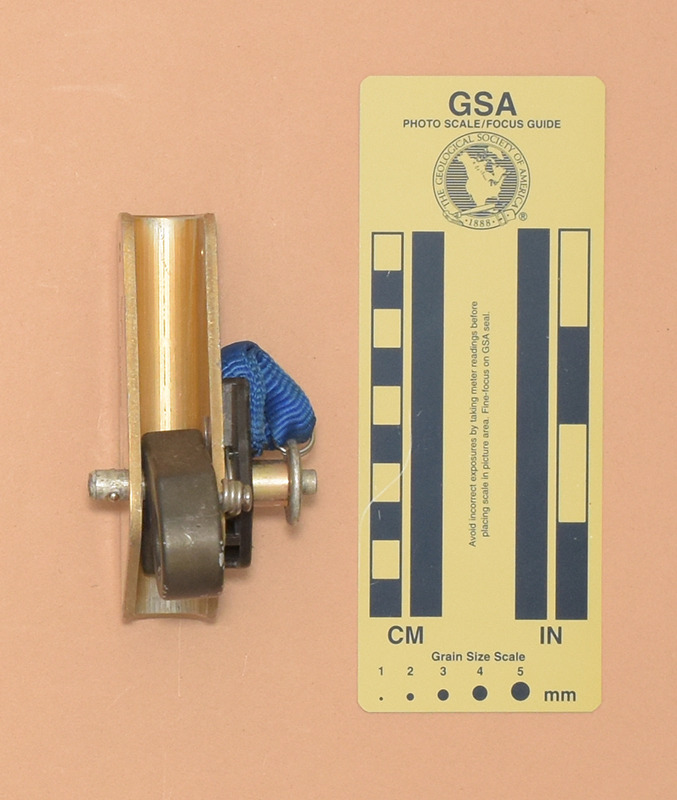
I acquired one Gibbs QR Spring Loaded, Version S from Jim Meadows in 2026. I acquired another from Chris Holzbach at the same time. The latter was anodized gray rather than the normal gold color.
This Gibbs is 104 mm. tall, 73 mm. wide, 57 mm. thick, and weighs 176 g.
The shell is made from 1/8" (3.2 mm.) aluminum alloy bent to form an 18 mm. wide U-shaped rope channel.
The cam is hard anodized cast aluminum. The cam radius increases from 15 to 34 mm. over an angle of 85°, giving a 28° cam angle There are nine teeth, and the cam toe is tapered so that the end teeth are narrower. A 7.8 mm. diameter quick release pin acts as the cam axle. The quick release pin keeper is a bight of 1/2" (13 mm.) webbing riveted to the spring housing. The keeper passes through a split ring attached to the QR pin.
A wire spring attaches to the cam by a 0hillips-head machine screw. The other end of the spring goes under a black plastic spring housing riveted to the shell, wraps once around the QR pin and then hooks over the end of a 0hillips-head screw passing through the cover.
Each side of the shell is stamped with "UP," an up-pointing arrow, and "GIBBS" with a double underline. The QR pin is stamped "AVIBANK 55207."
I prefer the cord keeper to the webbing keeper. Gibbs Products never found a good solution to the keeper problem. Cord and webbing keepers wear out, and stiff cable keepers are awkward to use.
[ Top
| Version A
| Version B
| Version C
| Version D
| Version E
| Version F
| Version G
| Version H
| Version I
| Version J
]
[ Version K
| Version L
| Version M
| Version N
| Version O
| Version P
| Version Q
| Version R
| Version S
]