

This page will not fit into a tiny viewport. Please choose a full-size monitor with a full-width window or select the abridged New Wave pages.


Version A

Version B
Version C

Version D

Version E

Version F
Version G

Version H1

Version H2
|
|
|
|
|
| Version A | Version B | Version C | Version D |
|
|
|
|
|
|
| Version E | Version F | Version G | Version H1 | Version H2 |
Peter Gibbs wrote the following in his company history:[1]
Vertical spelunking can be cold, wet, and extremely exhausting. Often the cave explorer is forced to rappel down a waterfall to get into a pit and then to ascend the rope, getting soaked and risking hypothermia. Early cavers used Prusik knots, inefficient, muscularly taxing knots that don’t hold well on wet rope.
In 1965 my brother, Charles, showed me a mechanical ascender he had built. I set out to manufacture it. I built 65 ascenders and sold a few of them to friends for places like Neff’s Cave.
That fall, at the National Speleological Society convention in Lovell, Wyoming, Charles entered a rope climbing contest. Using the newly minted Gibbs Ascenders, he cut the record time in half. I sold out that afternoon. Word spread rapidly and orders began coming in, but it was a very small market.
George Lowe, well known mountain climber and fellow physics student at the University of Utah, started using Gibbs Ascenders on his expeditions and writing them up in climbing magazine articles because they held well on ice cover ropes and were easy on the rope. That spread word around the world and opened up a second, larger market.
The cam in the first model Gibbs Ascender swung freely. Rock climbers wanted it spring loaded. Thus the second model was born.
Soon mountain rescue crews were using them for raising litters and ski resorts were using them to extract customers from stalled lifts. For their use, I added a stainless steel model and thicker aluminum model. And to give them more holding power, I put indents in the shell of the ascender.
Fire departments and rescue crews often use ropes more than half an inch thick so I added three quarter inch models next.
Over time Gibbs Ascenders found many niches to fill besides ascending ropes, including setting up rigging for rock concerts and protecting tree trimmers. There have been many modifications for specific markets but the basic design remains unchanged.
The earliest Gibbs were spring-wire models. Here is a quick summary of the versions in my collection (all have aluminum shells):
[ Top | Version B | Version C | Version D | Version E | Version F | Version G | Versions H1 & H2 | Return to L.C. Ascenders ]
|
|
 |
| Front | Rear |
 |
| Open for Rigging |
I acquired a pair of Gibbs Spring-wire, Version A ascenders at the NSS Auction in 1998.
Version A is 103 mm. tall, 64 mm. wide, 36 mm. thick, and weighs 148 g. The shell is bent from 1/8 in aluminum to form a U-shaped groove. The cam is cast aluminum. It has 11 teeth, and is tapered near the tip, something some copies have failed to do. The cam rides on a steel pin axle that is drilled at the end to accept a retainer. The retainers on this Gibbs are 0.1 inch nylon line. The same material is used as a pin keeper.
Subversion A1 has no markings. Subversion A2 has "GIBBS PROD." stamped once on the front of the shell and twice on the back.
Gibbs ascenders were the premier ascender for long free-hanging ascents, and are still a good option when rigged properly. This one is one of the first 65 made. This basic design has lasted for decades, almost without change.
[ Top | Version A | Version C | Version D | Version E | Version F | Version G | Versions H1 & H2 | Return to L.C. Ascenders ]
|
|
 |
| Front | Rear |
 |
| Open for Rigging |
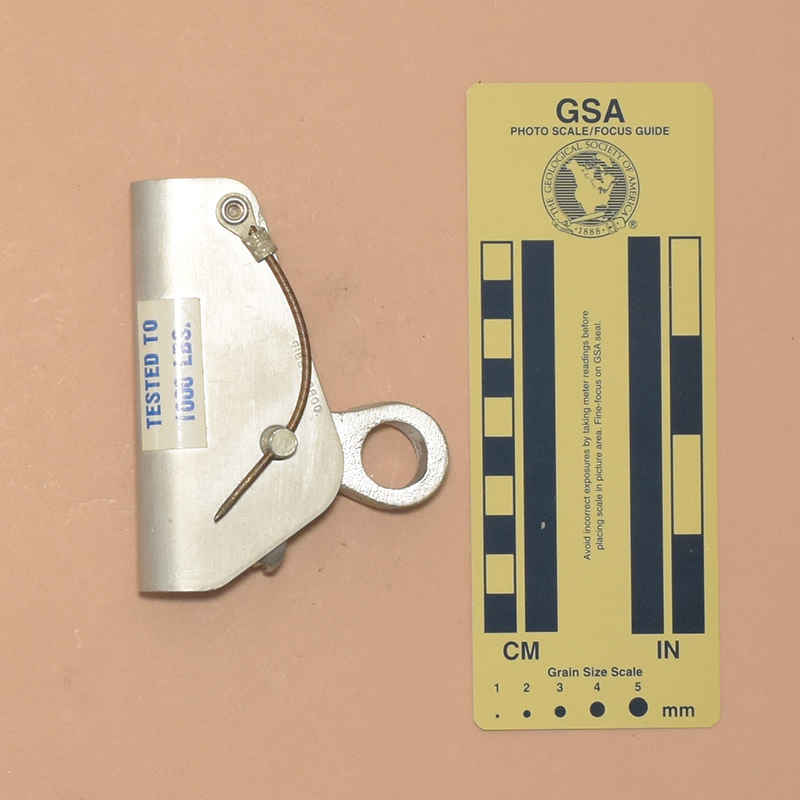
I acquired my Gibbs Spring-wire, Version B from Rick Banning at the 2019 NSS Convention.
Version B is 103 mm. tall, 63 mm. wide, 36 mm. thick, and weighs 154 g. The rope channel is 17 mm. wide. The cam radius increases from 19 to 34 mm. over an angle of 93°, giving a 20° cam angle. The retainers on this Gibbs are 2.4 mm. spring-wires. The same material is used as a pin keeper.
Version B has a sticker saying "TESTED TO 1000 LBS." Rich stamped his last name on the shell.
The spring-wire is a significant improvement over the nylon retainer.
Rick attached a tag to this ascender with the following note:
"Early Gibbs 1 May 19
somewhat cruder cam teeth
Rick Banning"
[ Top | Version A | Version B | Version E | Version F | Version G | Versions H1 & H2 | Return to L.C. Ascenders ]
|
|
 |
| Front | Rear |
 |
| Open for Rigging |
I acquired my Gibbs Spring-wire, Version C sometime in the 1980s, but I don't have any records of the acquisition. I acquired a pristine pair from Collectibles from Maine / John Freund in 2024.
Version C is 103 mm. tall, 64 mm. wide, 36 mm. thick, and weighs 152 g. This ascender uses the same cam, shell and pin as Version A, but the nylon retainer and pin keeper have been replaced with a spring wire (much like a thicker guitar string).
Both sides of the shell are stamped "GIBBS PROD."
The spring-wire would often get kinked like the one in the photo. This actually helped align it when rigging the ascender onto the rope.
[ Top | Version A | Version B | Version E | Version F | Version G | Versions H1 & H2 | Return to L.C. Ascenders ]
|
|
 |
| Front | Rear |
 |
 |
| Side | Open for Rigging |
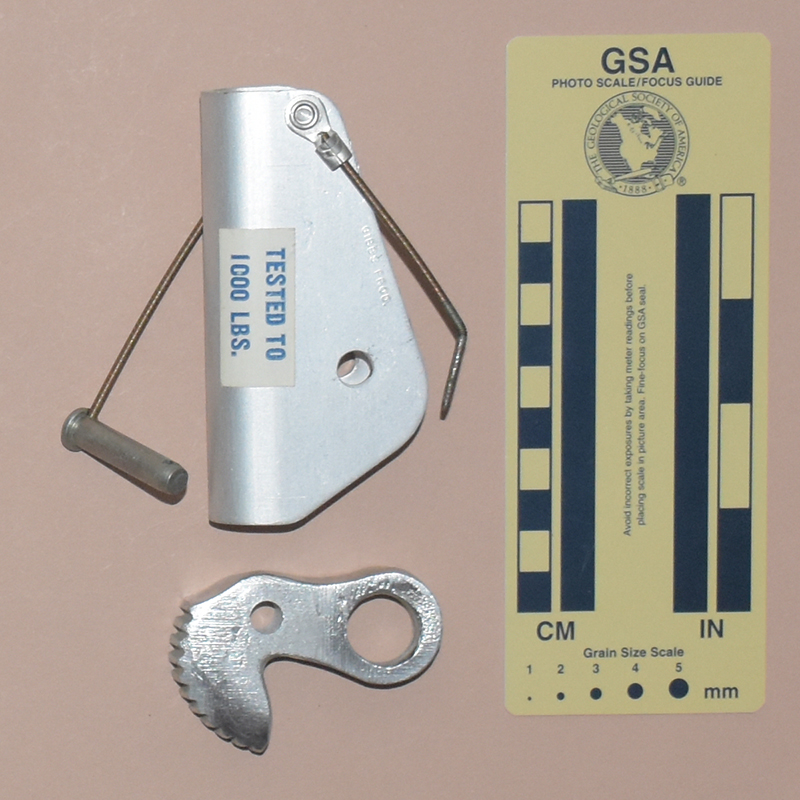
I acquired my Gibbs Spring-wire, Version D from Bill Boehle at the 2008 Old Timers Reunion. I acquired two more in 2017 as part of Bob Thrun’s collection.
Version E is 103 mm. tall, 59 mm. wide, 36 mm. thick, and weighs 150 g. The rope channel is 17 mm. wide. The cam radius increases from 16 to 32 mm. over an angle of 88°, giving a 25° cam angle.
This ascender uses the same cam, shell, and spring-wires. as Version C, but the cam pin has been changed. The spring-wire is now crimped into a hole drilled in the shaft, below the head, rather than a groove in the head.
Both sides of the shell are stamped "GIBBS PROD."
The new method of attaching the spring-wire is more secure than the old one was.
[ Top | Version A | Version B | Version C | Version D | Version F | Version G | Versions H1 & H2 | Return to L.C. Ascenders ]
|
|
 |
| Front | Rear |
 |
| Open for Rigging |
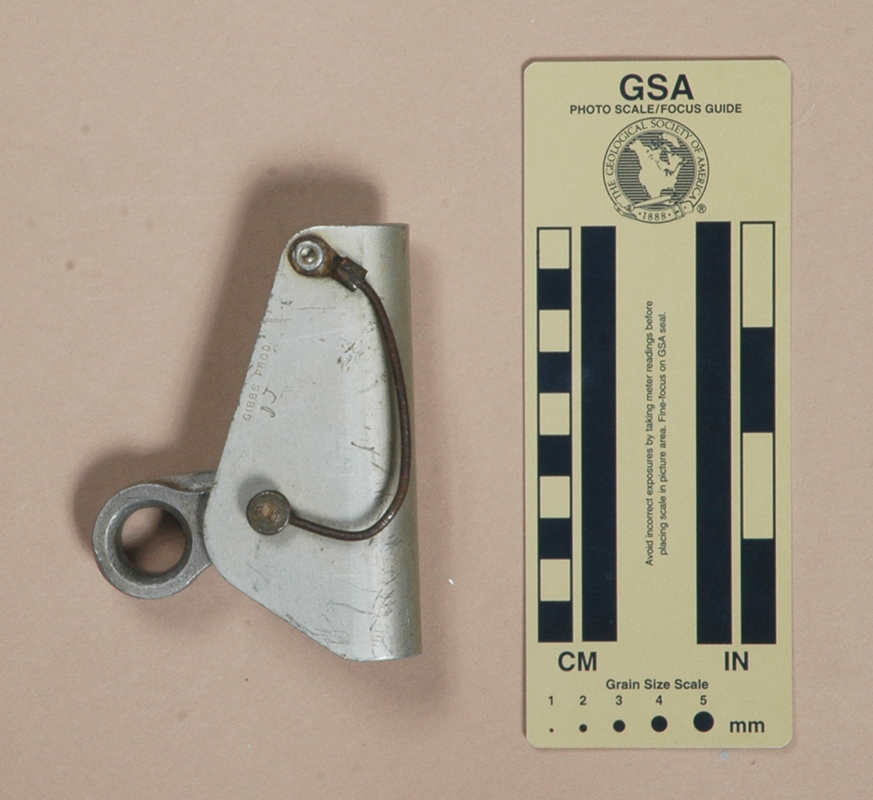
I acquired a Gibbs Spring-wire, Version E ascenders from Myra Nicholas in 2009 and a second from David Jones in 2014, both in used condition.
Version E is 103 mm. tall, 59 mm. wide, 36 mm. thick, and weighs 150 g. Version E features a new the cam design. The number of teeth was reduced to 9. The upper part of the cam was reshaped to give a distinct rib.
Both sides of the shell are stamped "GIBBS PROD."
The new cam performs better than the original. The rib is for aesthetic reasons, and serves no utilitarian function. The new cam was dubbed the "racing cam."
[ Top | Version A | Version B | Version C | Version D | Version E | Version G | Versions H1 & H2 | Return to L.C. Ascenders ]
|
|
 |
Front  |
Rear |
 |
| Open for Rigging |
 Technical Details
I acquired a Gibbs Spring-wire, Version F ascender from John E. Weinel, Inc. in 1989. I got a second one used on eBay from David Jones in 2014, two more in new condition from Bill Liebman at the 2017 Old Timers Reunion, and one from William Shrewsbury in 2021. I then received another pair in new condition, complete with original paperwork, from Michael S. McBride in 2022. Kim Fleischmann gave me another at the 2023 NSS Convention.
Version F is 104 mm. tall, 59 mm. wide, 37 mm. thick, and weighs 155 g. This version has a second terminal crimp for attaching a keeper cord. Unlike later designs, the cord is tied to the cam eye instead of being directly attached to the cam. The rib on the top of the cam is wider as well, 9 mm. instead of 5 mm. on the previous version.
Both sides of the shell are stamped "GIBBS PROD."
The photo is of one that I obtained from Michael S. McBride. The black cord keeper is original, but I had to tie it myself. I used the full length, although I would cut it in practice. All others of this version came with a red cord that matches the cord used on the following version. The second one in my collection has the crimp but is missing the cord. The "new" ones acquired from Bill came with cords, but it was left to the buyer to tie the cords to the cams.
[ Top | Version A | Version B | Version C | Version D | Version E | Version F | Versions H1 & H2 | Return to L.C. Ascenders ]
|
|
 |
| Front |
Rear |
 |
| Open for Rigging |
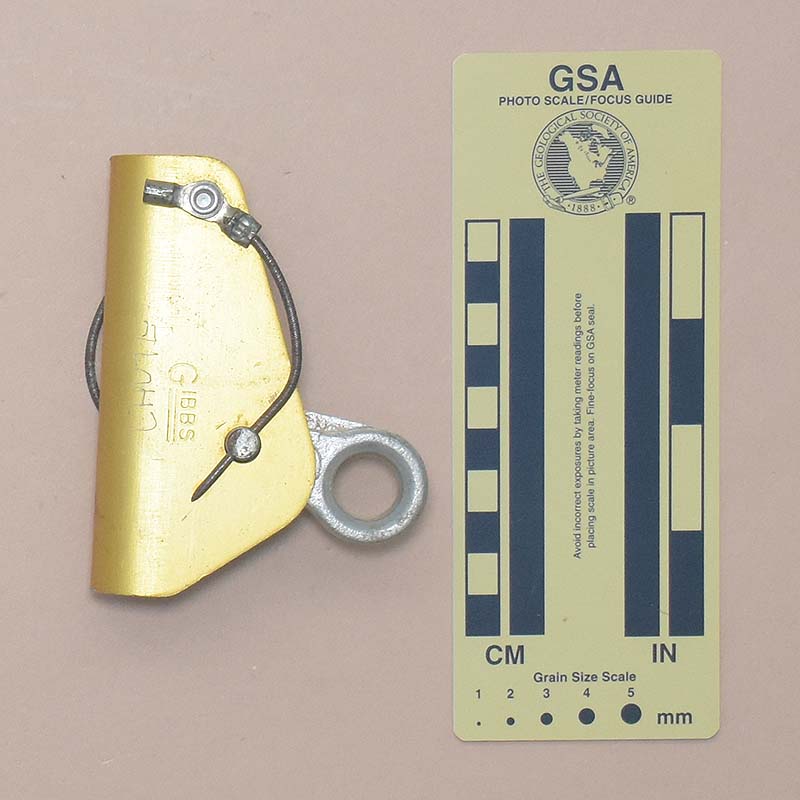
I acquired two Gibbs Spring-wire, Version G ascenders from Kelley Deem at the 2022 Old Timers Reunion.
Version F is 103 mm. tall, 59 71. wide, 37 36. thick, and weighs 154 g. This version has a second terminal crimp for attaching a keeper cord. Unlike later designs, the cord is tied to the cam eye instead of being directly attached to the cam. The rib on the top of the cam is 8 mm. wide.
Both sides of the shell are stamped "GIBBS PROD."
This version introduces the gold-colored anodized shell. Barry Chute owned these before Kelley, and scratched his name on the side and spine of the shells. Any keeper cords that may have been supplied with these ascenders were lost by the previous owners.
[ Top | Version A | Version B | Version C | Version D | Version E | Version F | Version G | Return to L.C. Ascenders ]
|
|
|
| Version H1 Front |
Version H2 Front |
 |
 |
| Version H1 Rear |
Version H2 Rear |
 |
 |
| Version H1 Open for Rigging |
Version H2 Open for Rigging |
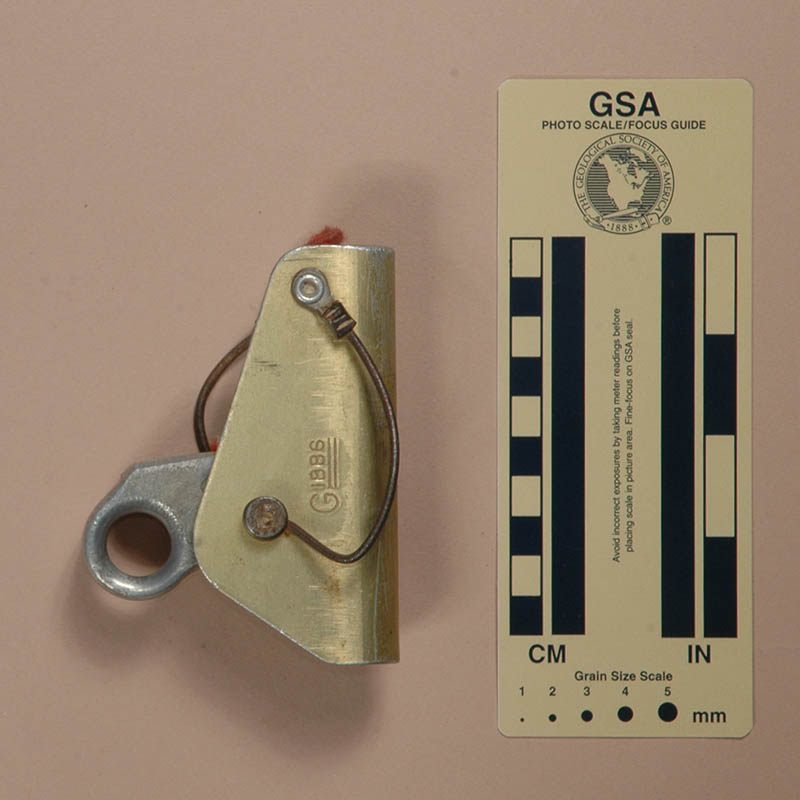
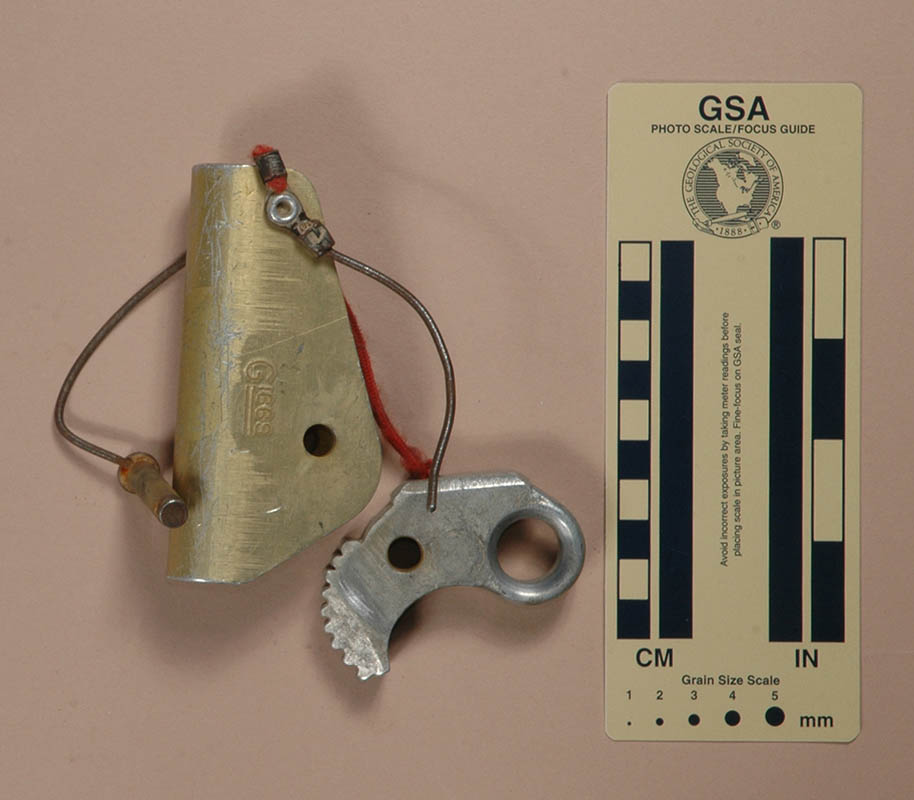
I acquired three Gibbs Spring-wire, Version H ascenders from Gibbs Products Inc. in 1973, and three more from J. W. Jackson in 2011. I acquired another in 2017 as part of Bob Thrun’s collection, and one from Rich Banning at the 2019 NSS Convention.
Version H is 104 mm. tall, 59 mm. wide, 36 mm. thick and weighs about 182 g. Version H introduced yet another cam design, also with 9 teeth. The rib was eliminated. A hole was drilled in the top and side of the cam, and a keeper cord was glued in place. The shell is anodized.
Both sides of the shell are stamped "GIBBS" with a double underline.
I have two minor variations of this version, one with the cam keeper cord attached to the left side of the shell and one to the right.
 |
 |
 |
 |
[ Top | Version A | Version B | Version C | Version D | Version E | Version F | Version G | Versions H1 & H2 ]