

This page will not fit into a tiny viewport. Please choose a full-size monitor with a full-width window or select the abridged New Wave pages.


|
|
|
Version B |
 |
Version A |
Bob Thrun described the H-Bar and its use but not its origin[1]. We have not found a published original description.
Gary Storrick eyeballed the H-Bar drawing in Bob's book and then made two of them in 2004.
Gary Storrick, NSS 12967 FE CM, began caving, climbing, and collecting vertical equipment in 1971. He created this web site in 1999, and earned an NSS Certificate of Merit in 2024 for his work. Back in the day, his father Robert had some small equipment made for him in the shops that he managed. Gary now makes samples in his home machine and wood shops to aid his research. He suggests, "I may have tried more devices than the average caver."
[ Top | Version B | Return to Semi-mechanical Ascenders ]
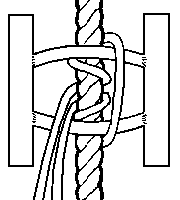 Bob Thrun describes the H-Bar knot in his book Prusiking as "a semi-mechanical version of the Prusik knot," although in his illustration (reproduced here), the rope follows the path of a strap hitch (Ashley’s #1694). It works either way, sliding more easily than a Prusik but not holding as well.
I made my H-Bars from 11 mm. and 6.6 mm. mild steel (A36). The horizontal pieces were press fit to the vertical bars. The original H-Bars were welded; I intend to weld mine someday when I get my MIG unit working.
[ Top | Version A | Return to Semi-mechanical Ascenders ]
I decided that I placed the horizontal bars too far apart on Version A, so I moved them closer on Version B. I made the side bars longer to reduce the chance of the sling slipping off the H-Bar.
[ Top | Version A | Version B ]