

This page will not fit into a tiny viewport. Please choose a full-size monitor with a full-width window or select the abridged New Wave pages.


|
|
 |
| Front View: Closed | Rear View: Closed |
 |
 |
| Front View: Open for Rigging | Rear View: Open for Rigging |
I acquired my Proverti CD 211 and CD 212 from Ondřej Belica in 2015.
The Proverti CD 211 and CD 212 are each 207 mm. tall, 93 mm. wide, 30 mm. thick, and weigh 292 g.
The shell is milled from aluminum alloy and then soft anodized. The hand hole is roomy, and a rubberized plastic grip is riveted to the frame. The rope channel is 16 mm. wide.
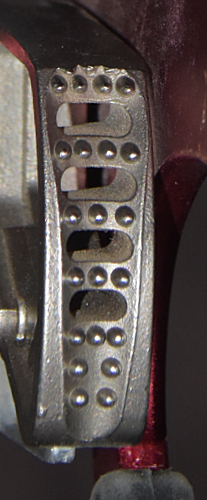 The cam is a skeletonized casting. The cam radius, measured from the pivot, increases from 36 to 56 mm. over an angle of 42°, giving a 31° cam angle. The cam has number of small conical teeth, all of which have their axes approximately parallel to the upper surface of the cam. The teeth are fairly dull compared to those of other toothed ascenders. In between the teeth rows are four oval holes which open to the central vacancy of the cam. The holes and teeth both decrease in size towards the toe of the ascender. The tooth/hole pattern is (3)(4.H)^2(3.H)^2(3.2.2). A spring-loaded manual safety bar is mounted on the bottom of the cam with a steel semi-tubular rivet. The normal action of the spring holds the safety against the cam. When the cam is opened, the shell interferes with the safety bar, thus preventing opening the cam. If the safety bar is moved away from the cam (opposing the spring), it will clear the shell and the cam will open. At full open the safety can be released and the spring will hold the safety against the back of the shell. This provides a means of locking the cam open. The lower portion of the safety is bent outward to form a thumb tab to assist in operating the safety mechanism.
The back of the ascender is printed with "PROVERTI," a book-with-an-"i" icon, a rigging illustration, "CD 211" ("CD 212 on the right-hand ascender), a hollow up-pointing arrow containing the words "UP" and "ASCENSION," ROPE O9<Ø<13," "EN 567," the UIAA logo, "CE0082," and "www.proverti.com."
I gave mixed feelings about this ascender.
The frame is acceptable, but heavy, and I don't mind the hand grip. The extrusion matches the one used for the Swiss Rescue Jumar. The lower portion (beneath the handgrip and below the bend in the front strap) appears to be identical to the Swiss Rescue Jumar’s shape, but the upper portion is larger, with a higher cam channel, a longer rope channel, and a larger upper hole arch. This makes the Proverti 25 mm. taller and 43 g. heavier.
The cam appears to be copied from the cam on the Kong Cam-Clean, but the implementation is sloppy. There is a sharp serrated ridge above the top teeth. The teeth are rounded; I would actually call them dull. The cam flops around on its axle, but you may not notice this because the cam safety flops around far more. The hold-open action barely works. Opening the ascender with one had is very difficult. The tab on the safety is rather small, allowing one’s thumb to slip off rather easily.
The CD 211 is the left-hand, red ascender. The CD 212 is the right-hand ascender, anodized blue.
The Proverti brand is owned by Protekt, a Polish firm founded in 1989 in Łódź. Protekt specializes in products designed to protect against falling from a height. Protekt's products include safety harnesses, safety shock absorbers, safety cables, and permanent safety systems. Combining the experience gained during many years of production of harnesses and equipment for industrial mountaineering with the passion of our employees, Protekt decided to launch the Proverti brand focusing on the production of sports harnesses and climbing equipment. Proverti had its own web presence from 2014 until 2019.