

This page will not fit into a tiny viewport. Please choose a full-size monitor with a full-width window or select the abridged New Wave pages.

|
|
 |
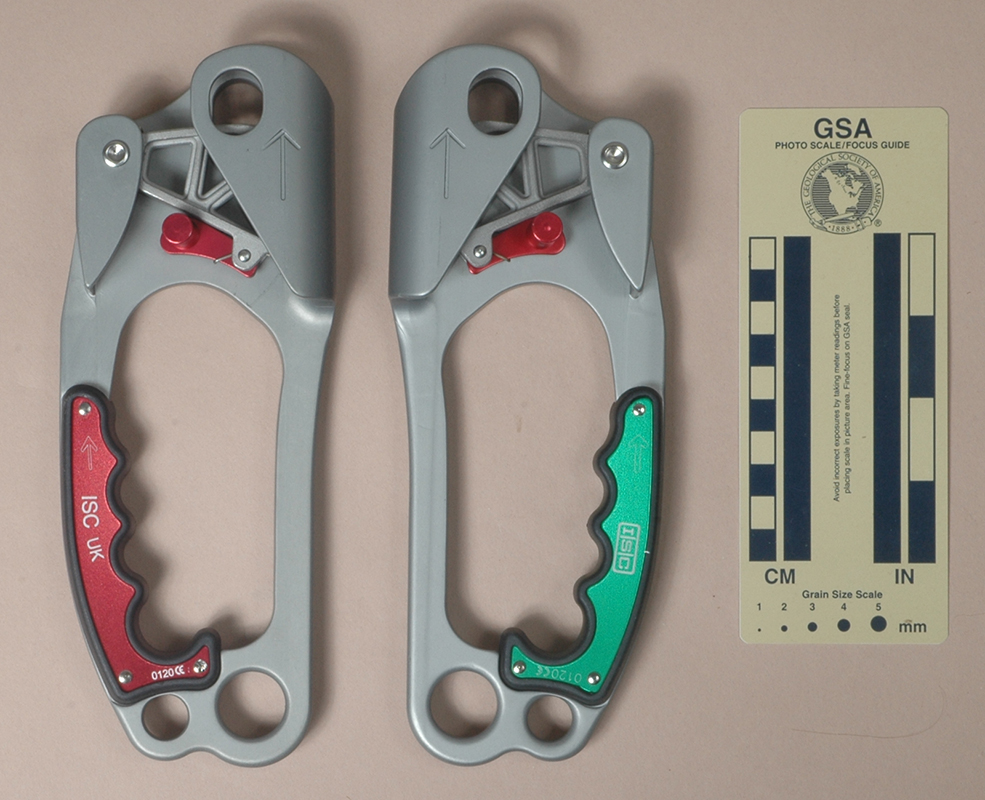
| Front View: Closed (ISC on Left, Yates on Right) |
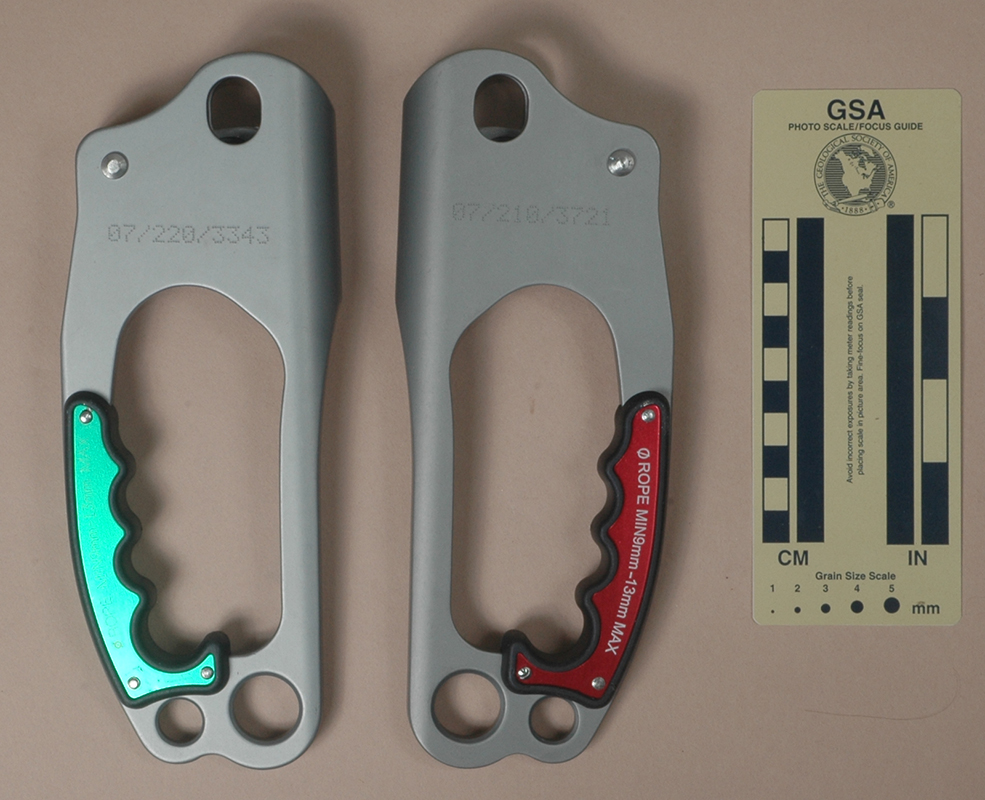
Rear View: Closed (ISC on Left, Yates on Right) |
 |
 |
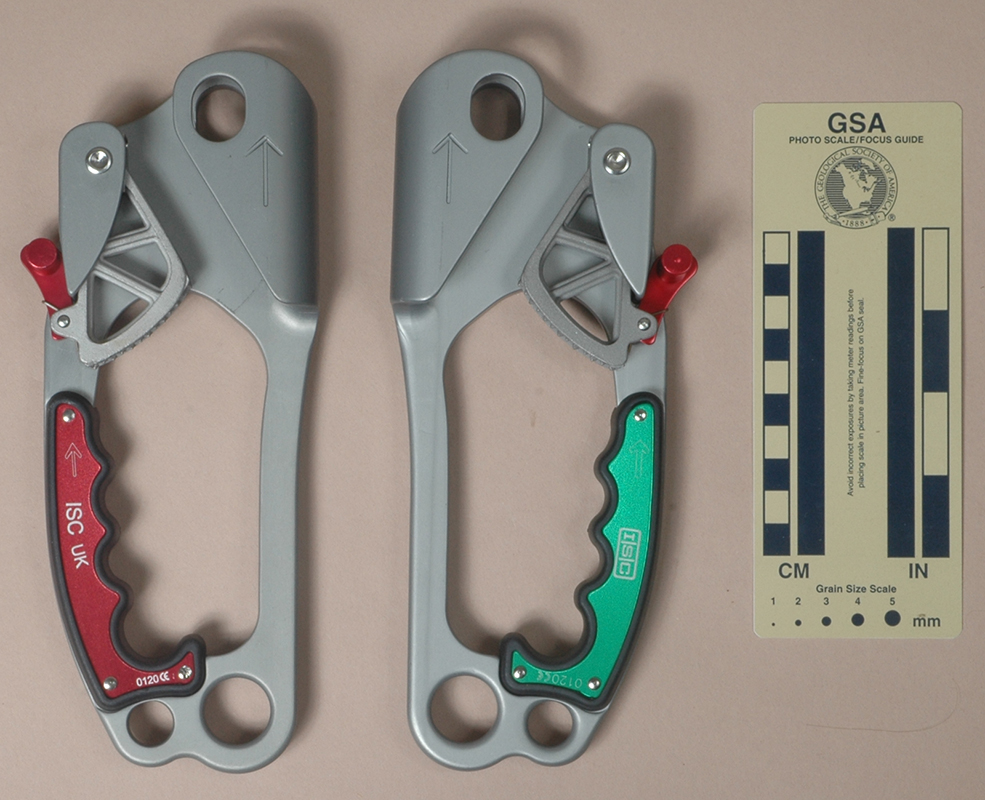
| Front View: Open for Rigging (ISC on Left, Yates on Right) |
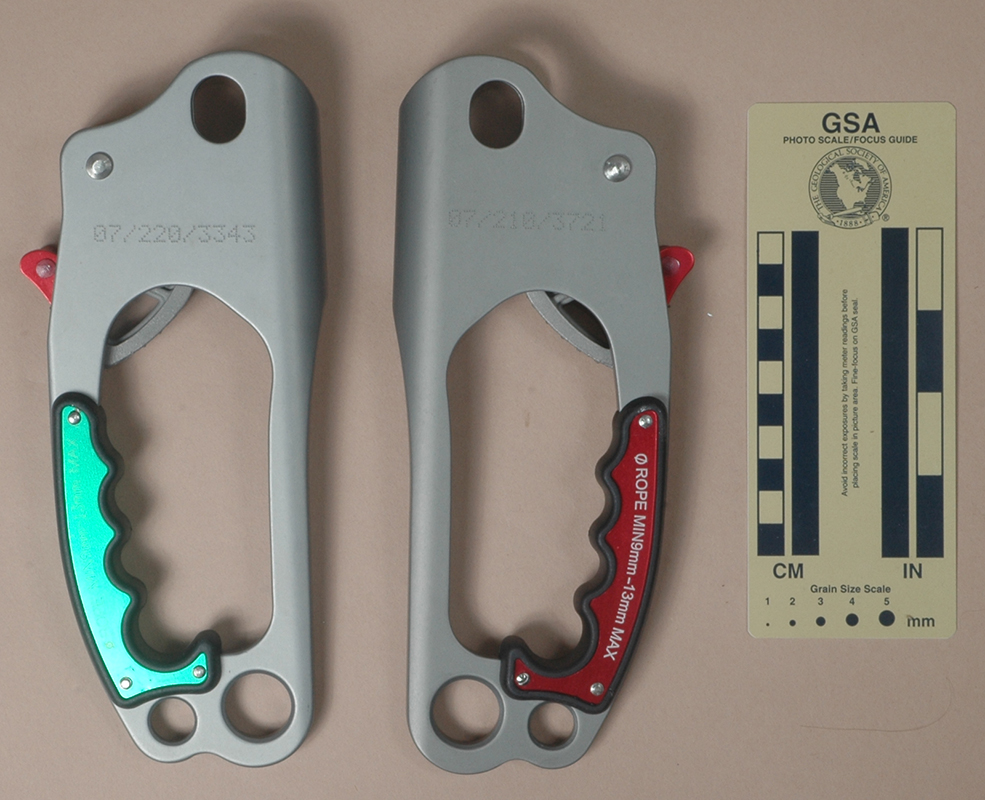
Rear View: Open for Rigging (ISC on Left, Yates on Right) |
I acquired a right-handed Yates Big Wall ascender from Acme Climbing in 2009. I acquired a pair in 2017 as part of Bob Thrun’s collection.
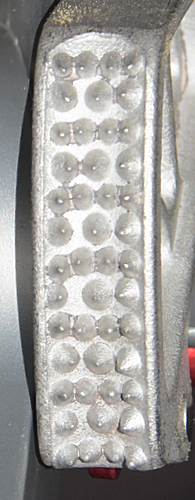 The Yates is essentially the same as the ISC Big Wall, Version B ascender (it is even marked "ISC" instead of "Yates," but it came with Yates documentation), so I only got one of each. My Yates Big Wall is 217 mm. tall, 84 mm. wide, 32 mm. thick, and weighs 370 g. The shell is milled from a custom aluminum extrusion and hardcoated. The extrusion and overall rounded shape of the ascender are similar to the S.R.T. A1 Explorer. Like the S.R.T. (and the CMI), the extrusion direction is oriented parallel to the vertical axis of the ascender, and contains two opposing channels. One channel is rounded and becomes the rope channel; the other is square and holds the cam. The rope channel is 15 mm. wide. The angled hand hole is roomy, and a rubberized plastic grip with aluminum insets is riveted to the frame. A 20 mm. hole and a 13.5 mm. hole are drilled at the bottom and a 16.2 by 20 mm. hole is milled through both sides of the rope channel. The hand hole is made a little wider than on the CMI 5000, so the rope channel barely protrudes from the ascender body as on the CMI 5000 series and S.R.T. Caver/climber series.
The cam is a plated skeletonized, reinforced stainless steel casting with a (4.3)^6(4) conical tooth count. The cam radius increases from 42 to 61 mm. over an angle of 41°, giving a 24° cam angle. The tooth axes are perpendicular to the cam face. The teeth are well-formed. The cam, cam spring, and a cam housing are mounted on a 5 mm. semi-tubular rivet. The cam housing is a piece of thin sheet metal bent to cover the top of the cam channel and serve as a spacer along the sides of the cam. The top of the housing is flat instead of indented (compare it with the S.R.T. Caver/climber series). The cam safety is a spring-loaded piece of 3 mm. red anodized aluminum mounted on a 3 mm. stainless steel rivet placed through two tabs on the base of the cam. A small thumb knob is staked to the safety. The knob is turned to give a contoured grip. The safety is placed so that it does not interfere with one’s hand in the handle.
The front of the rope channel has a milled up-pointing arrow. The back of the frame is etched "08/220/8472." The aluminum inset on the front side of the grip is marked with an arrow pointing up, an ISC logo, and "0120CE." The rear inset is marked "ø ROPE MIN9mm-13mm MAX."
Although the Yates and ISC Big Wall, Version B are the same design made by the same company, my original Yates was made a year later than my ISC Big Wall, Version B. I immediately noticed that the cam teeth on the Yates are not as nice as the ones on the older ISC. The ICS teeth were all nicely made, evenly spaced, and separated, while the teeth on the Yates are uneven, sometimes crooked, and occasionally run together. They still work, but are not as pretty. Bob’s Yates were made a year before mine, and the teeth on his looked like those on the ISC Big Wall, Version B.
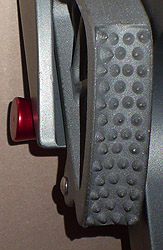 ISC Cam |
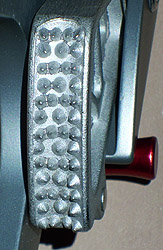 Yates Cam |
Observant readers will notice that the rivet holding the ISC Big Wall, Version B cam safety has a round head, while the one on the Yates is countersunk.
 |
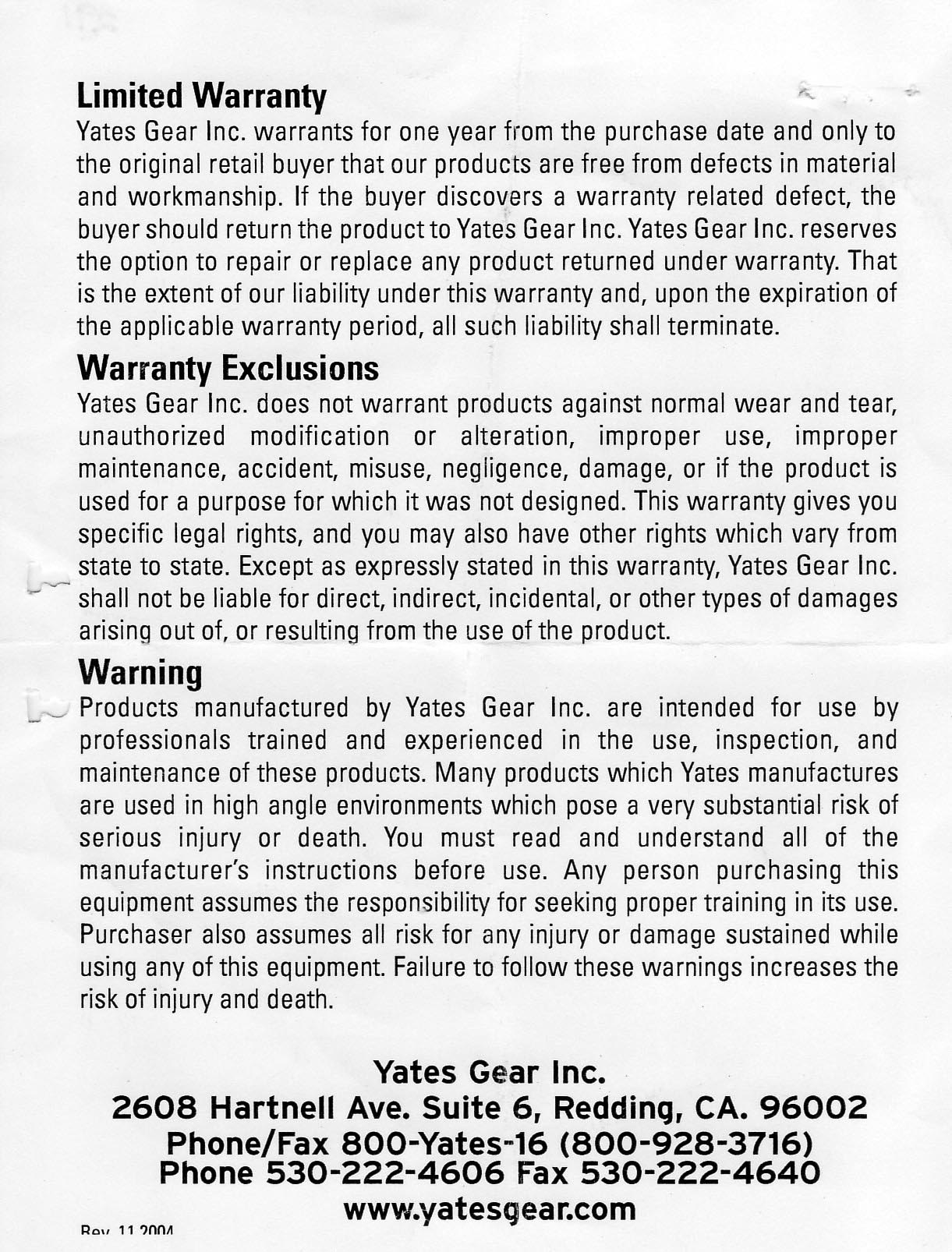 |
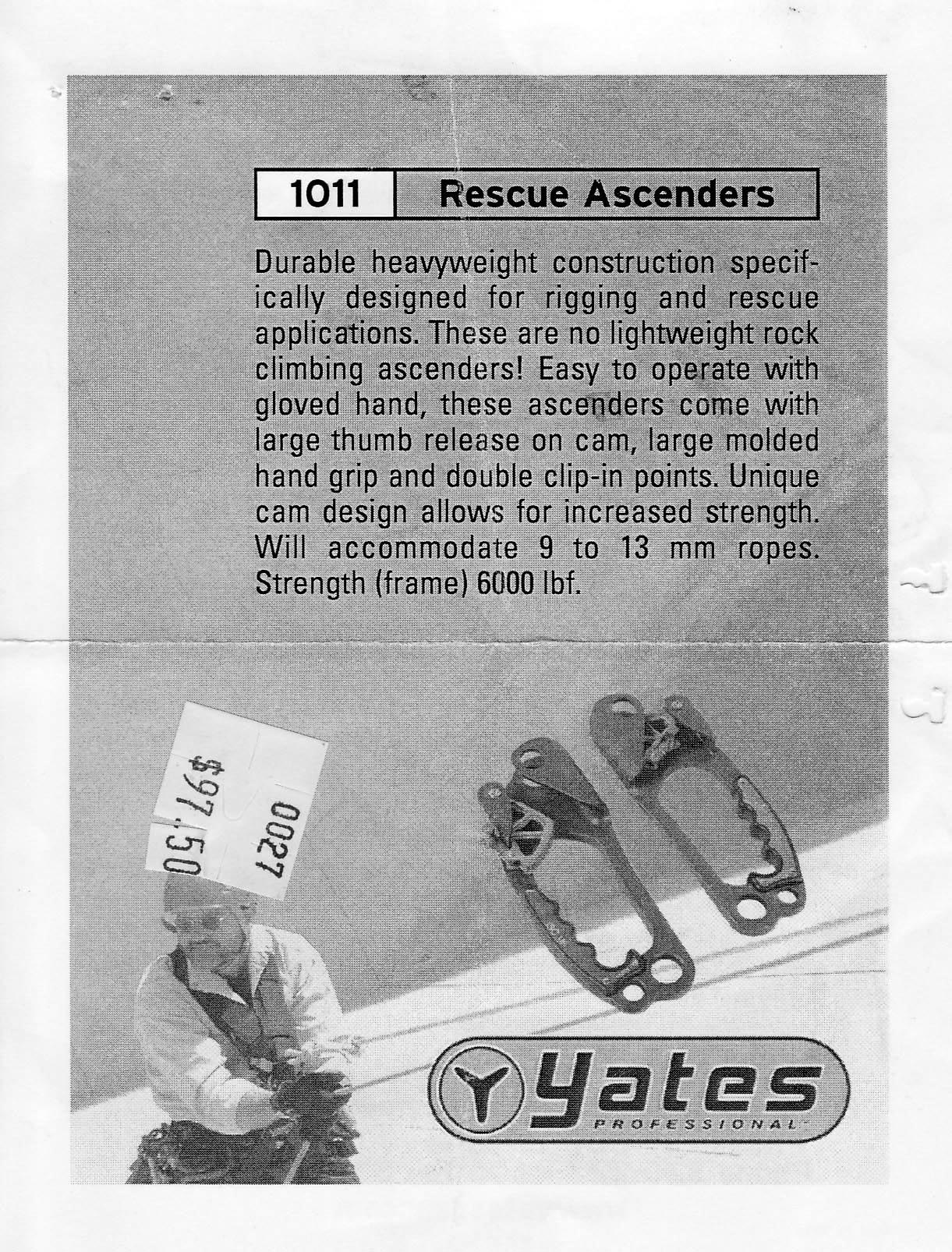
This Yates ascender was made by ISC.
Yates Gear was started in 1982 by James and John Yates, with its foundation being manufacturing mountaineering and rock climbing equipment. Yates' background in big wall climbing has shown through in the design and development of rescue, rigging, rope access and tactical specific equipment.Yates sewn products are manufactured in Redding, California. The Vertical Supply Group acquired Yates in 2024.
-----Formed in 1966 and headquartered in North Wales, International Safety Components (ISC) is a global provider of height safety equipment. They design and manufacture equipment for a variety of industries including Arborist, Rope Access, Rope Rescue, and Adventure Parks. Their focus is on industrial and heavy use applications.