

This page will not fit into a tiny viewport. Please choose a full-size monitor with a full-width window or select the abridged New Wave pages.


|
|
 |
| Front | Rear |
 |
 |
| Side | Open for Rigging |
I made this ascender in 2021.
This ascender is 122 mm. tall, 124 mm. wide, 38 mm. thick, and weighs 602 g.
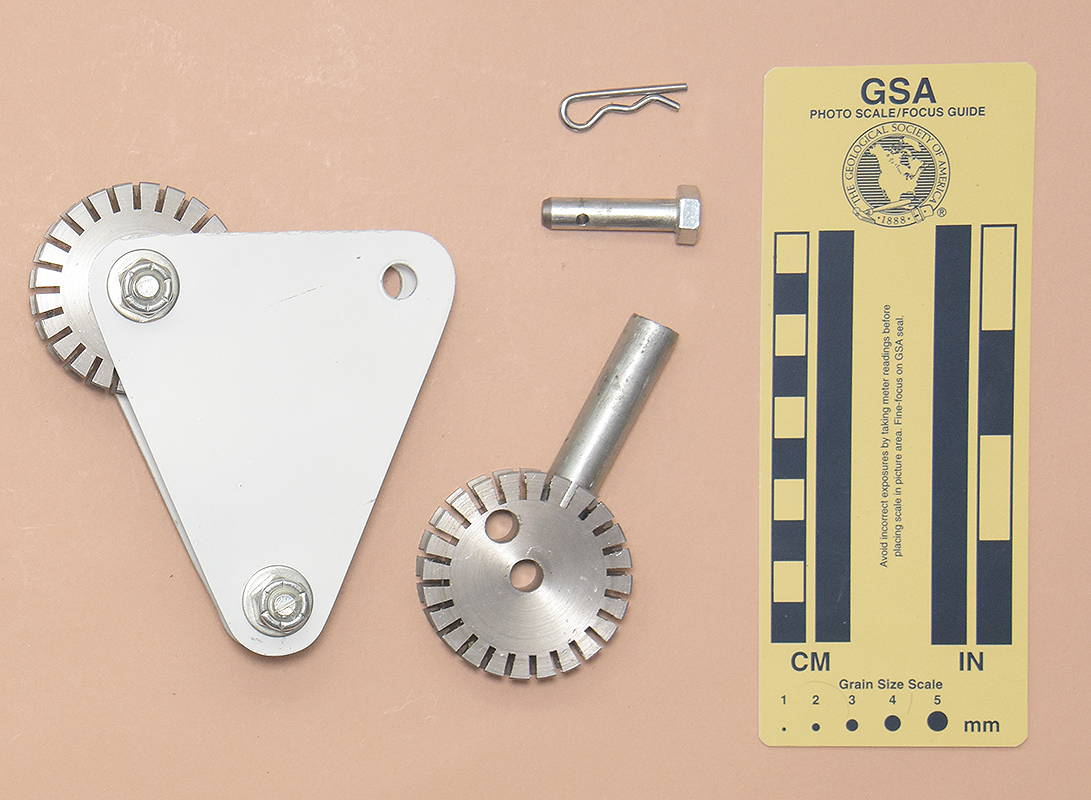
The plates are made from 1.4 mm. 4140 steel. The roller and cam are made from 1018 steel. They are 51 mm. in diameter and 15.1 mm. thick. Each has an 11.5. wide, 3.2 mm. deep U-shaped groove around its perimeter, and 24 slots spaced evenly at 15° intervals. The roller is bolted between the plates with a 5/16–18 UNC stainless steel bolt, washers, and lock nut, leaving enough slack to allow rotation. The cam has a hole drilled 13.5 mm. from the center to provide an eccentric camming action. A 12.7 mm. mild steel rod threaded into the cam protrudes 43 mm. from the cam. The cam axle is a pin made from a 5/16" bolt. It is cross-drilled for a small hairpin. A 15.5 mm. long, 17.3 mm. diameter spacer bolted between the lower end of the plates provides a sling attachment point.
I based this ascender on ascenders in the NSS Museum. One of the Museum ascenders had a sling attached, suggesting that it was used as a chest ascender. The other was bolted to a steel angle, suggesting that it was used as a Mar–Bar ascender.
 |
 |
 |
The "teeth" on the originals are irregularly-spaced saw cuts, probably done by hand. I used a dividing head to space the slots evenly, and a thicker slitting saw to make the grooves. In theory, my deeper, thicker slots should help the ascender handle mud better than the original. If it should start to slip, the lever can be used to increase the cam's grip.
When rigging the ascender, one must use the off-center hole in the cam; otherwise the cam will not grip. The centered hole was used for construction only; in particular, to bolt the cam blank to a fixture held in the dividing head.
I should put keepers on the cam axle and the hairpin to keep them from being lost; however, I chose not to since they were absent on the originals.
This is a heavy ascender, being made of steel, but that was typical of the 1960s technology.
Gary Storrick made this ascender in 2021. He based this ascender on two ascenders in the NSS Museum, scaling the dimensions from photos that I took in late 2021. The originals were donated to the Museum in March 2008, possibly by Bob Barlow. We believe that the ascenders were made by Frank Shires in the early 1960s while Frank was at the U. of Virginia, and that these were part of the club's shared gear used up through the early 1970s.
The "teeth" on the originals are irregularly-spaced saw cuts, probably done by hand. Gary used a dividing head to space the slots evenly, and a thicker slitting saw to make the grooves, thankfully not having it explode on him in the process like thin slitting saws tend to do in his shop.
Gary Storrick, NSS 12967 FE CM, began caving, climbing, and collecting vertical equipment in 1971. He created this web site in 1999, and earned an NSS Certificate of Merit in 2024 for his work. Back in the day, his father Robert had some small equipment made for him in the shops that he managed. Gary now makes samples in his home machine and wood shops to aid his research. He suggests, "I may have tried more devices than the average caver."