

This page will not fit into a tiny viewport. Please choose a full-size monitor with a full-width window or select the abridged New Wave pages.

Simple

Simple +
|
|
|
| Simple | Simple + |
Climbing Technology was founded in 1986 by Even Carlo Paglioli under the legal name Aludesign, SpA. Based in Cisano Bergamasco, Italy, they manufacture a wide range of products for outdoor (climbing, mountaineering, etc.) and professional (rope access, rescue, etc.) activities. Skylotec acquired Aludesign / Climbing Technology in 2021.
[ Top | Simple + | Return to E.C. Ascenders ]
|
|
 |
| Front View: Closed | Rear View: Closed |
 |
 |
| Front View: Open for Rigging | Rear View: Open for Rigging |
I acquired a Climbing Technology Simple from Knot & Rope Supply/Amazon.com and another from Expé-Spelemat, both in 2015.
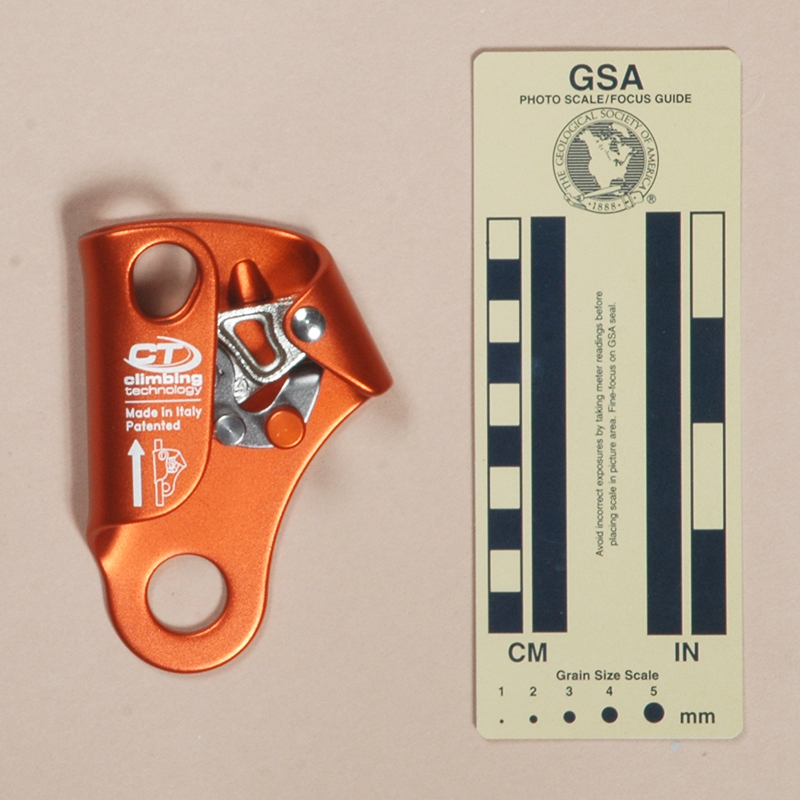
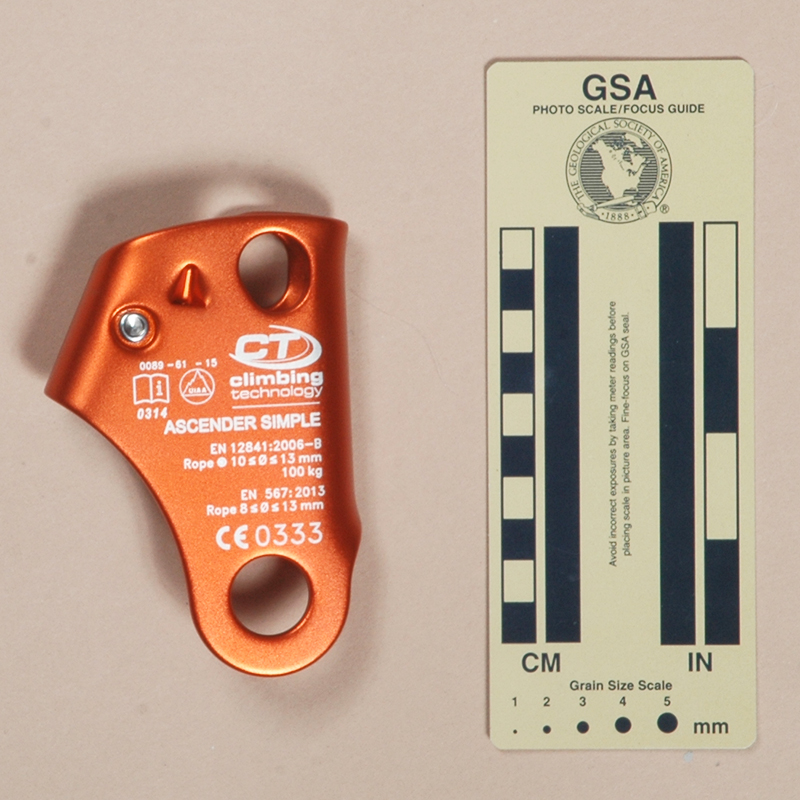
The Simple is right-handed. This ascender is 110 mm. tall, 75 mm. wide, 28 mm. thick, and weighs 154 g.
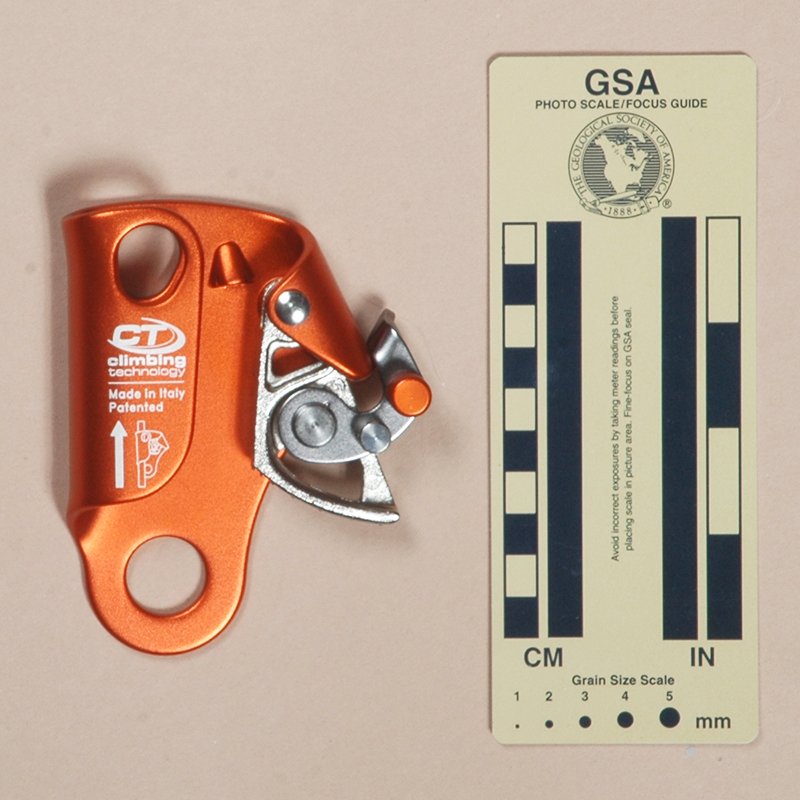
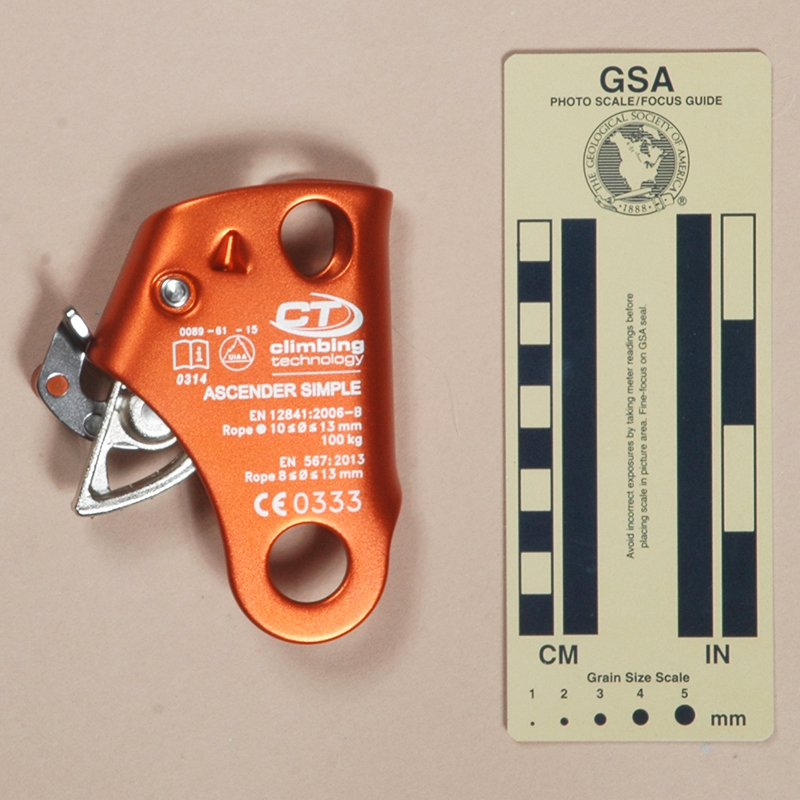
 The ascender shell is subtriangular orange anodized shape bent from 3.9 mm. aluminum sheet. The rope channel is formed by bending the left side of the ascender into a U. The rope channel is 15.9 mm. wide. The main sling attachment point is a 19 mm. circular hole located below the cam and to the right of the rope channel. There is an upper attachment point above the cam, passing through both sides of the rope channel. The upper opening is pear shaped, 18.7 mm. high by 15.8 mm. wide. The right side of the shell is bent on an inclined axis to form another U. A hole drilled through both sides of the U accepts a semi-tubular rivet. The cam and cam spring are mounted on this rivet. The head of the rivet is on the front while the roll sits into a stamped depression on the back of the shell. The pivot is centered 49 mm. from the inside of the rope channel. There is a stamped cam stop near the cam pivot.
This ascender uses a standard Climbing Technology cam found on many of their chest, hand, handled, double-rope, and foot eccentric cam ascenders. The cam is a plated skeletonized steel casting. The cam radius,measured from the pivot, increases from 38 to 57 mm. over an angle of 40°, giving a 31° cam angle. The cam has numberof small conical teeth, all of which have their axes approximatelyparallel to the lower surface of the cam. The tooth pattern is(3.2.4)(1H1.2)^3(3.2), where the "H" stands for a 4 mm. wide, 6 mm.wide inverted subtriangular hole.
A spring-loaded manual safetyis mounted on an axle riveted to the center of the cam. The normal action of the spring holds the safety against the cam.When the cam is opened, the shell interferes withthe safety tab, thus preventing opening the cam. If the safetyis moved away from the cam (opposing the spring), the tab willclear the shell and the cam will open. At full open the safetycan be released and the spring will hold the arm against the back of the shell, locking the camopen.
The front is printed with the CT logo, "climbing technology," "Made in Italy," "Patented," an up-pointing arrow, and an illustration of the ascender on rope. The rear is printed with "0089 - 61 - 15," a book-with-an-"i" icon, "0314," the UIAA logo, the CT logo, "climbing technology," "ASCENDER SIMPLE," "EN 12841:2006-B," "Rope • 10≤Ø≤13 mm," "100 kg," "EN 567:2013," "Rope 8≤Ø≤13 mm," and "CE0333." The cam has "L2" in raised characters.
 |
Warning: The weight ("100kg") printed on the shell can easily be less than the weight of a fully loaded caver. |
|
The small pin on the cam safety performs an interesting function: pushing down on the larger pin causes the safety tab to lever the cam open, but not enough to let the rope free. This provides an alternate way to "thumb" the ascender. The cam drags on the back of the shell when using this method.
The holes in the cam face are intended to reduce the risk of ascender slippage due to mud-caked cam teeth. The design appears superior to some, but most ropes muddy enough to stop other ascenders will stop the this one as well. If you climb muddy ropes, expect to encounter slipping problems with any eccentric cam ascender.
This Simple is essentially the same as the Repetto Stalin (also made by Climbing Technology) that I acquired in 2008, with minor differences such as the knurled pin on the safety.
The weight ("100kg") printed on the rear of each ascender can easily be less than the weight of a fully loaded caver. Although I know what this means, American courts may not, so I cannot recommend this ascender for heavier cavers or for expedition caving.
[ Top | Simple + | Return to E.C. Ascenders ]
|
|
 |
| Front View: Closed | Rear View: Closed |
 |
 |
| Front View: Open for Rigging | Rear View: Open for Rigging |
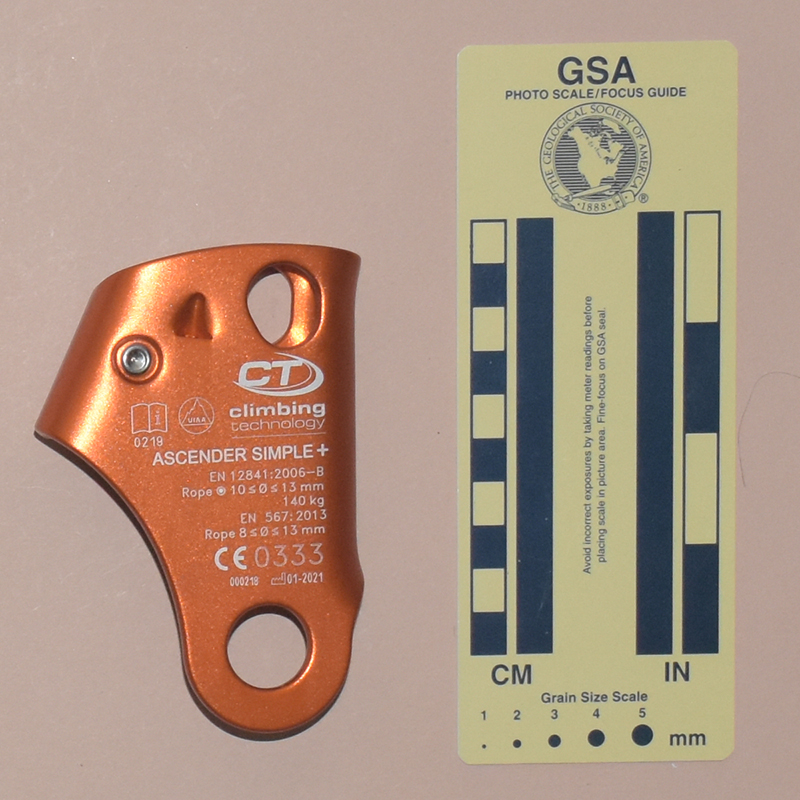
I acquired my Climbing Technology Simple + from Canyon Store in 2021.
The Climbing Technology Simple + is 110 mm. tall, 75 mm. wide, 28 mm. thick, and weighs 154 g.
 The ascender shell is subtriangular orange anodized shape bent from 3.9 mm. aluminum sheet. The rope channel is formed by bending the left side of the ascender into a U. The rope channel is 16 mm. wide. The main sling attachment point is a 19 mm. circular hole located below the cam and to the right of the rope channel. There is an upper attachment point above the cam, passing through both sides of the rope channel. The upper opening is pear shaped, 18.7 mm. high by 15.8 mm. wide. The right side of the shell is bent on an inclined axis to form another U. A hole drilled through both sides of the U accepts a semi-tubular rivet. The cam and cam spring are mounted on this rivet. The head of the rivet is on the front while the roll sits into a stamped depression on the back of the shell. The pivot is centered 49 mm. from the inside of the rope channel. There is a stamped cam stop near the cam pivot.
This ascender uses a standard Climbing Technology cam found on many of their chest, hand, handled, double-rope, and foot eccentric cam ascenders. The cam is a plated skeletonized steel casting. The cam radius,measured from the pivot, increases from 38 to 57 mm. over an angle of 40°, giving a 31° cam angle. The cam has numberof small conical teeth, all of which have their axes approximatelyparallel to the lower surface of the cam. The tooth pattern is(3.2.4)(1H1.2)^3(3.2), where the "H" stands for a 4 mm. wide, 6 mm.wide inverted subtriangular hole.
A spring-loaded manual safetyis mounted on an axle riveted to the center of the cam. The normal action of the spring holds the safety against the cam.When the cam is opened, the shell interferes withthe safety tab, thus preventing opening the cam. If the safetyis moved away from the cam (opposing the spring), the tab willclear the shell and the cam will open. At full open the safetycan be released and the spring will hold the arm against the back of the shell, locking the camopen.
The front is printed with the CT logo, "climbing technology," "Made in Italy," "Patented," an up-pointing arrow, and an illustration of the ascender on rope. The rear is printed with a book-with-an-"i" icon, the UIAA logo, the CT logo, "climbing technology," "ASCENDER SIMPLE +," "EN 12841:2006-B," "Rope • 10≤Ø≤13 mm," "140 kg," "EN 567:2013," "Rope 8≤Ø≤13 mm,"CE0333," "000218," a factory icon, and "01-2021." The cam is stamped "I6."
|
Warning: The weight ("140kg") printed on the shell can easily be less than the weight of a fully loaded caver. |
|
The small pin on the cam safety performs an interesting function: pushing down on the larger pin causes the safety tab to lever the cam open, but not enough to let the rope free. This provides an alternate way to "thumb" the ascender. The cam drags on the back of the shell when using this method.
The holes in the cam face are intended to reduce the risk of ascender slippage due to mud-caked cam teeth. The design appears superior to some, but most ropes muddy enough to stop other ascenders will stop the this one as well. If you climb muddy ropes, expect to encounter slipping problems with any eccentric cam ascender.
The Simple + is tested to 140 kg per EN 12841:2006-B, rather than 100 kg for the older Simple. I do not read too much into this, as it does not affect my applications. Heavier cavers carrying loads may appreciate the increased "official" strength rating, but they should realize that 140 kg. can easily be less than the weight of a fully loaded caver. Although I know what this means, American courts may not, so I cannot recommend this ascender for heavier cavers or for expedition caving.