

This page will not fit into a tiny viewport. Please choose a full-size monitor with a full-width window or select the abridged New Wave pages.

|
|
 |
 |
| Front | Rear | Top |
 |
 |
 |
| Front: Open for Rigging | Rear: Open for Rigging | Bottom |
I acquired my Beal Tract Up on eBay from Stacy Williams in 2018.
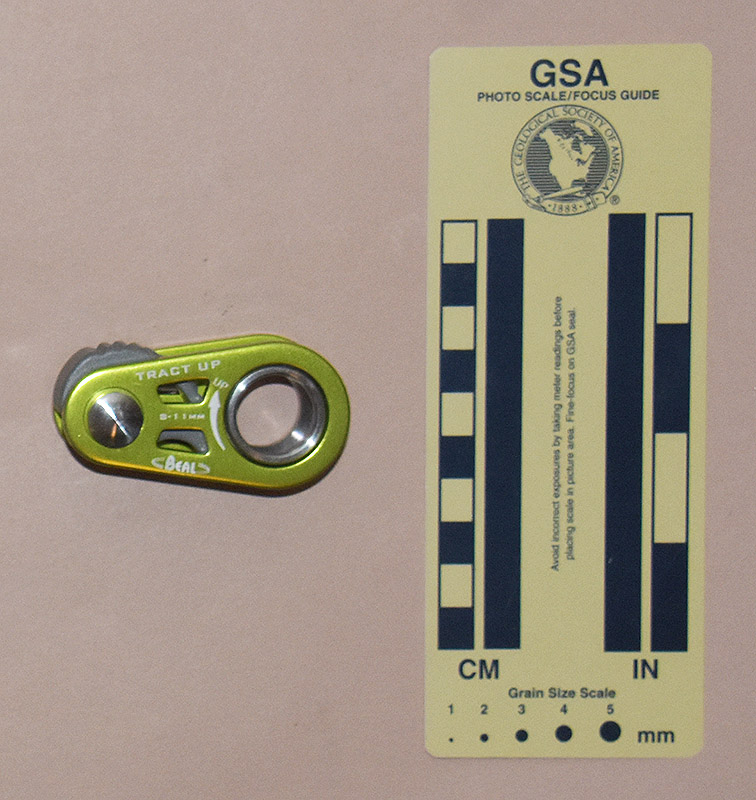
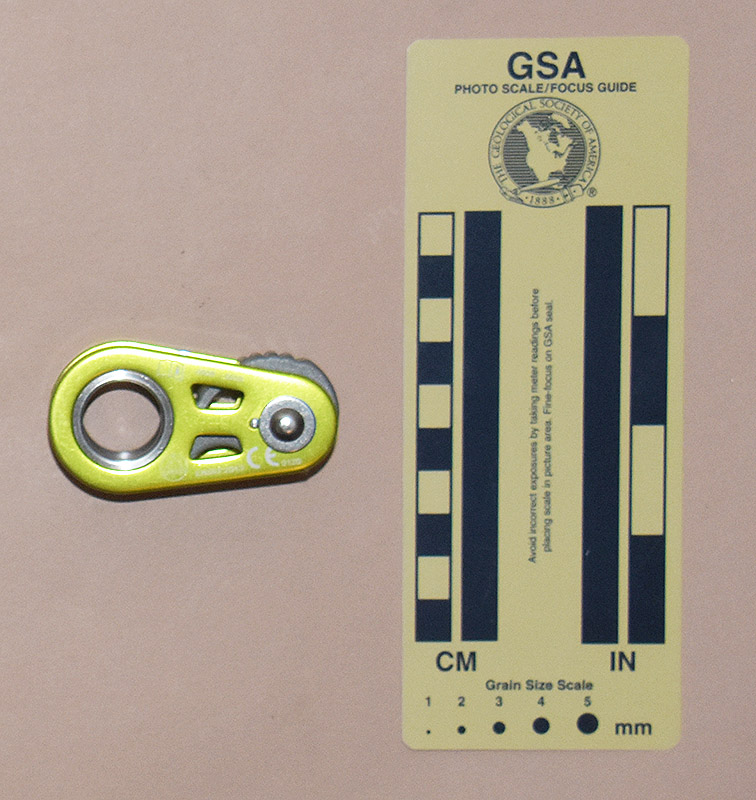
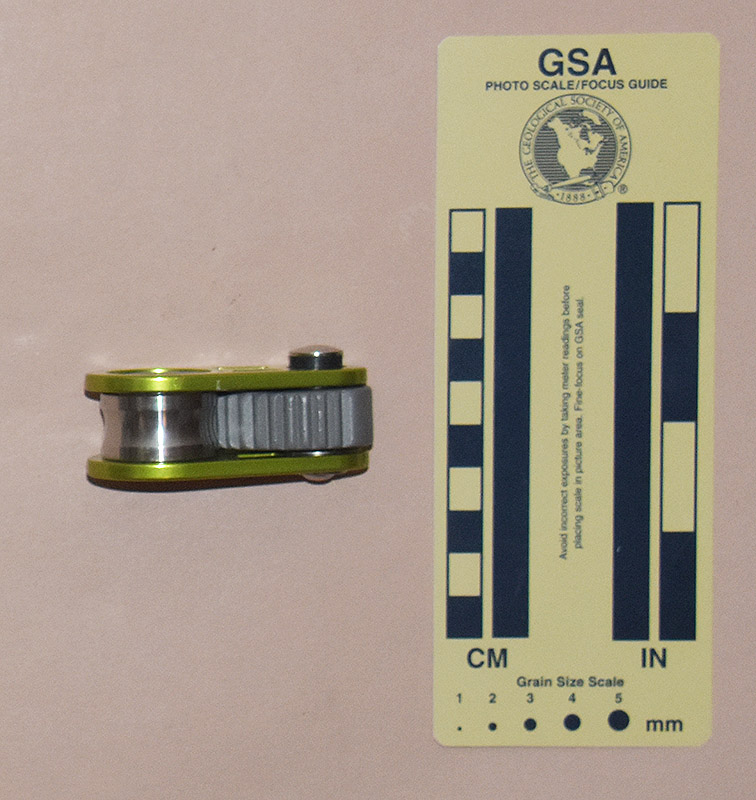
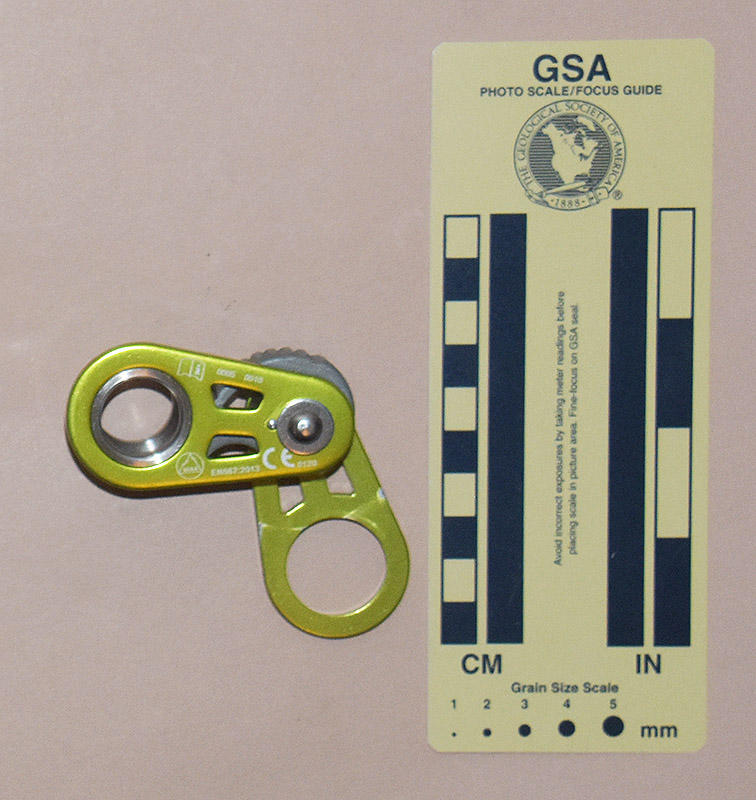
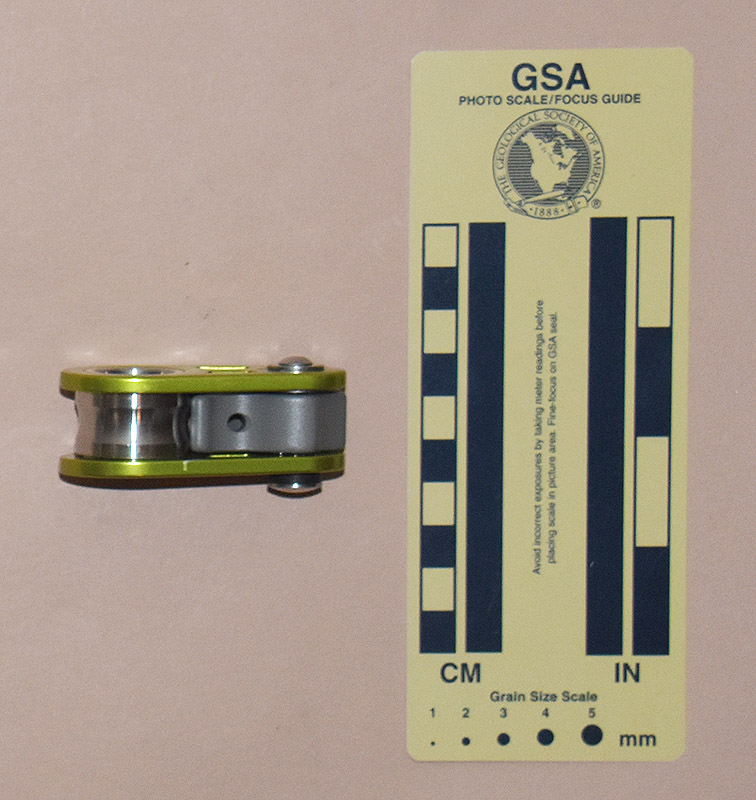
 The Beal Tract Up is 34 mm. tall, 66 mm. wide, 31 mm. thick, and weighs 89 g. The body of the Tract Up consists of an aluminum alloy spool crimped to a 3.9 mm. aluminum alloy plate. The spool’s outer diameter is 26.7 mm., and a shallow U-shaped groove reduces the diameter to 24.9 mm. where the rope rides. The inside of the spool is 18.1 mm. in diameter. The rope channel is 15.7 mm. wide.
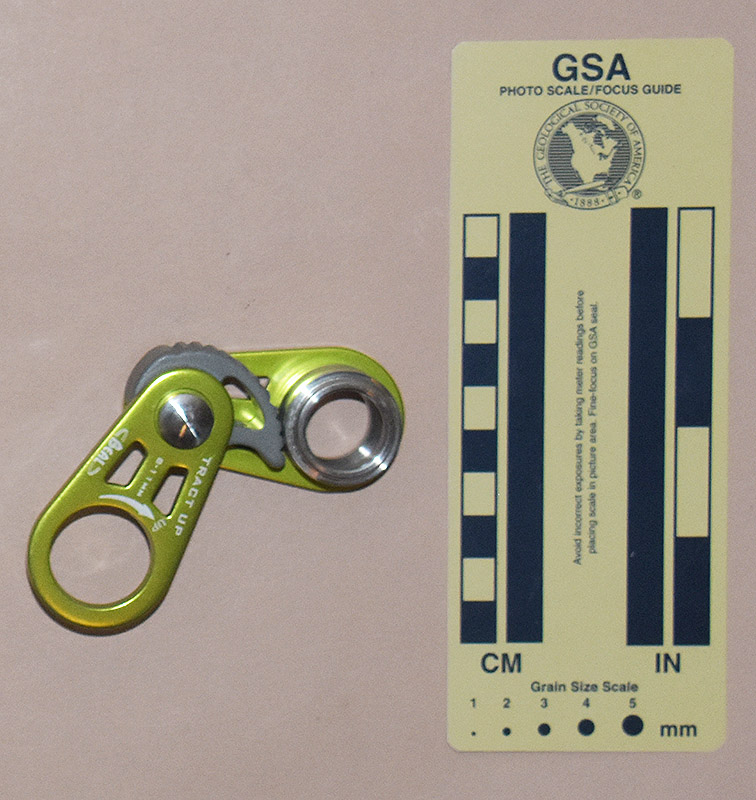
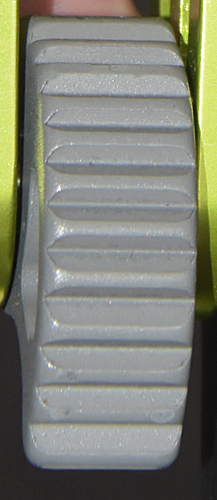
The cam axle is riveted to the back plate, with a steel washer under the riveted head protecting the aluminum plate. The cam is spring loaded, but the spring is not visible. A small roll pin pressed into the back plate probably forms a bearing surface for one end of the cam spring. The cam axle is about 6 mm. in diameter (I would have to destroy the ascender to get an accurate measurement). The axle is centered 26 mm. from the inside of the rope channel. The cam radius increases from 13 to 27 mm. over an angle of 145°, giving a 15° cam angle. The cam has 12 rounded teeth. The cam has a hole for attaching a piece of 2 mm. accessory cord that is supplied with the ascender.
The front plate is made from 3 mm. aluminum alloy. A 23.3 mm. hole lines up with the spool and back plate holes. When closed, the hole encloses a rim on the spool. The cam axle has a rubber washer outside the front plate that acts as a spring to force the plate toward the back plate.
The front plate is printed with "TRACT UP," "8-11 mm," "UP" above a curved arrow, and the Beal logo. The rear plate is printed with a book-with-an-"i" icon, "0005•0518," the U.I.A.A. logo, "EN567:2013," and "CE 0120."
The Beal Tract Up has the same body and spool as the Edelweiss microB, but the cam is different. It also bears a strong resemblance to the Kong Duck.
I find that I need two hands to rig the Tract Up. Only the top few teeth engage when I use 11 mm. rope, and the rounded teeth slip under unfavorable conditions. The conical teeth on the Mouse hold better. The clip-in hole is quite close to the main line and is opposite the cam, so there is little lost motion (less than two centimeters) when loading the ascender.
Janine & Pierre Beal founded Beal in 1951, producing cords and shoe laces. In 1974, their son Michel joined the family business. He went to the mountain show in Grenoble in 1975 and immediately noticed that Beal cords looked like mountaineering ropes. He decided that Beal would now produce climbing ropes. Michel met and worked with Yannick Seigneur, an intense French guide and engineer. A year later, in 1976, Beal presented its first climbing rope at the mountain show in Grenoble. While still focusing on ropes, they market harware and other products as well.